What Is a Business Proposal?
A business proposal is a strategic document that presents an idea, product, or service to potential partners, clients, or investors. It highlights the uniqueness of your company and its offerings over its competitors.
Stakeholders refer to the proposal to see how your company can address their needs and solve specific problems. This document outlines how your company plans to help, including its action plan and timeline. Depending on the goal, a good business proposal can lead to successful outcomes, including:
- Business contracts
- Partnership agreements
- Purchase orders
- Consulting agreements
- Bidding opportunities
Business proposals can either be solicited or unsolicited. A solicited proposal responds to a request for proposal. Meanwhile, the proposer initiates an unsolicited proposal. No matter how it starts, a business proposal can help with business development and client acquisition.
Business Proposal vs. Business Plan
A business proposal targets external parties to secure specific opportunities. Meanwhile, a business plan outlines a company’s strategy and goals. The latter document guides the business internally and attracts potential lenders.
| Difference | Business Proposal | Business Plan |
|---|---|---|
| Purpose | Persuade a client or partner | Serve as a roadmap |
| Target Audience | Clients, partners, & investors | Investors, lenders, and internal stakeholders |
| Update frequency | For one-time opportunities | Receives regular updates |
| Timeframe it covers | Short-term or project-based | Long-term vision for the entire company |
| Focus | Specific project | Company overall |
| Level of Detail | Narrow and tailored to the project | Comprehensive and in-depth |
How to Write a Business Proposal
When you know the key elements to include in your business proposal, you can create a persuasive document that highlights your business’s value and expertise. Follow these steps to show you understand the client’s needs and define your offerings.
Step 1 – Create a Cover Page
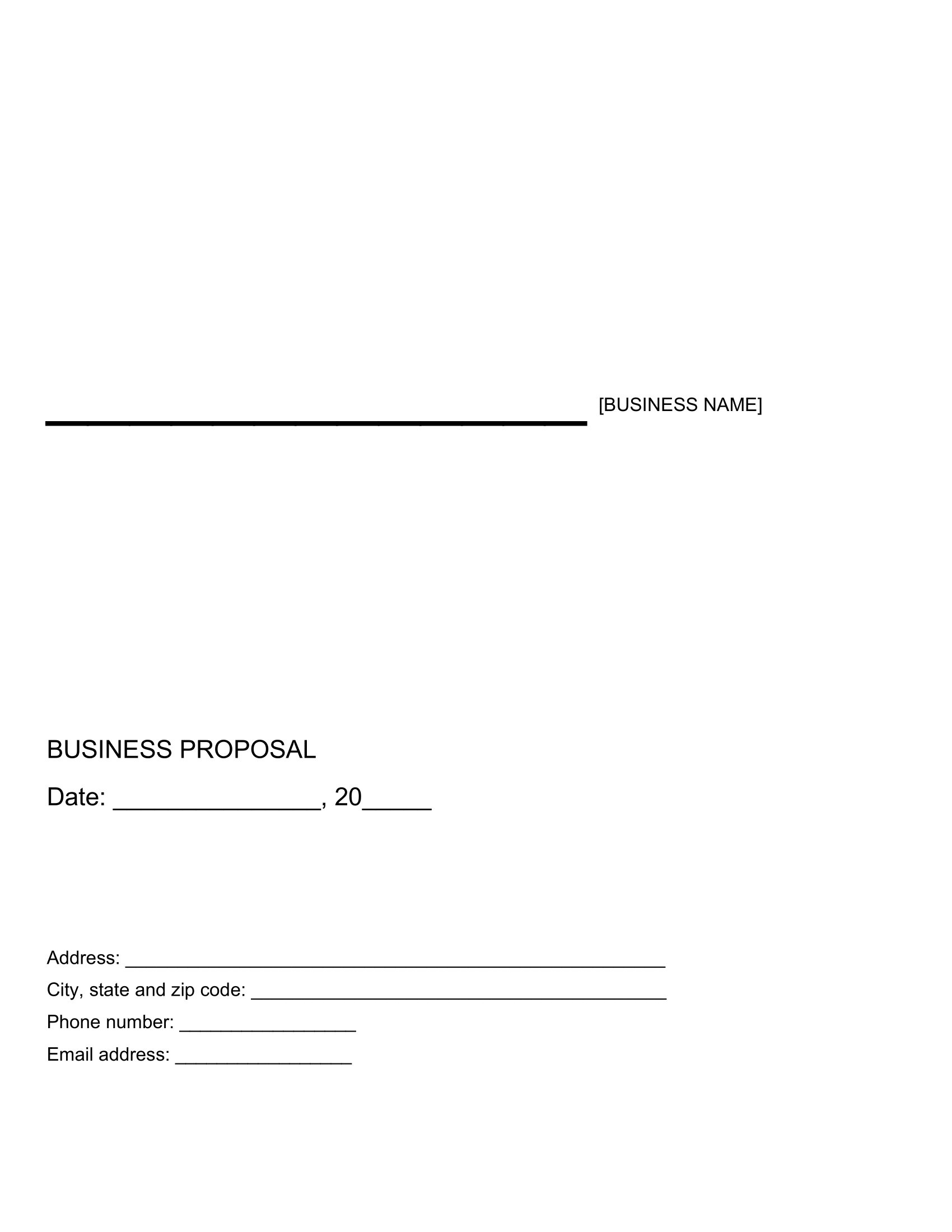
Create a cover or title page that makes it clear to the client or partner where the proposal is coming from. Title the document “Business Proposal” and specify the type of proposal for clarity, such as:
- Website Development Proposal
- Consulting Services Proposal
- Partnership Proposal
- Investment Proposal
Include your company’s street address, city, state, and zip code. Provide an email address and phone number so the collaborator can easily contact you to follow up with the work proposal. Write the date to provide context.
Keep the Design Simple
Keep your cover page and the rest of the proposal simple to focus on your value proposition. Legal Templates’s guided form makes it easy to create a clear, professional proposal without unnecessary formatting or complexity.
Step 2 – Provide a Project Overview
Provide an informative overview of the proposed project. Begin with the names of the document preparer and recipient, making it clear who the proposal is intended for. Explain how the business will support the recipient’s goals by:
- Describing the products or services the company offers
- Recognizing the challenges they face
- Explaining how the business will address its challenges
To guide the creation of your overview, conduct research on the specific client or partner to determine their pain points. Review case studies and conduct data analysis to learn where they could use assistance with their operations. Use your findings to tailor your business proposal, emphasizing why you’re the right business for their needs.
Step 3 – Write an Executive Summary
An executive summary is a brief overview of a business proposal. It presents the key points and gives readers a quick understanding of your value proposition and what you’re seeking. It’s important to make your executive summary both enticing and informative, as it often determines whether the reader proceeds to the rest of the document.
You can also use your executive summary to highlight your company’s qualifications and expertise. Show your past successes to prove that you’re the right business to work with.
Step 4 – Include a Scope of Work
Go into detail and outline how your solution will address your client’s specific needs. Create an action plan that explains:
- What deliverables you will present
- How you plan to do it
- When the client or stakeholder can expect results
Start by describing the solution clearly and in detail. Be specific about what’s included in your scope of services to set clear expectations from the beginning.
You should also include a rough project timeline. Let your client know when key project milestones will be reached. If possible, add projections or measurable outcomes, like how your solution will improve efficiency or solve their pain points. The more detailed and organized your scope of work documentation is, the more confident your stakeholders will feel.
Step 5 – State Your Target Audience
Define your target market, explaining who will benefit from your offerings and why they’re an ideal audience. This information helps the stakeholder understand the potential reach and impact of your proposed work. With a clear audience in mind, you can show that your proposal is focused and results-driven.
Step 6 – Outline the Financial Details
A financial proposal outlines costs and potential returns to help your partner understand its value. Start by providing your projected revenue, profits, and key expenses. Include a timeline for breaking even and reaching your return on investment (ROI).
Clearly explain payment structures, such as upfront costs, recurring fees, or profit-sharing. Highlight financial benefits with specific details like annual ROI or profit distribution terms. For instance, you may state that “Partners will receive 15% of net profits, paid quarterly.”
Transparency in your financial details builds trust and helps clients see the value of your proposal.
Step 7 – Finalize Terms & Sign
The terms and conditions section outlines the rules and expectations to prevent misunderstandings. Define the relationship’s scope, roles, responsibilities, decision-making, profit sharing, and support.
Include operational details like timelines, confidentiality, dispute resolution, and consequences for unmet obligations. For partnerships or franchising, address investments, shared responsibilities, and ongoing support. Clear terms build a solid foundation for the relationship and ensure the parties’ alignment.
Review for Clarity
Before signing the proposal, review it for clarity. Ensure the messages are succinct and focused so the recipient knows what you’re offering. Confirm that the document contains the following elements:
- Table of contents (helps the recipient quickly find important sections)
- A clear call-to-action (CTA)
- Personalized solutions to the recipient’s problems
Sign the document as the proposing company or individual. Allow the proposal receiver time to review the document before signing. Depending on the proposal’s terms, signatures may lead to the start of work or funding.
Example Business Proposal Template
Here’s an example of a business proposal where a cafe wants to collaborate with a partner:
Greenleaf Cafe
PARTNERSHIP BUSINESS PROPOSAL
January 27, 2026
992 Leonard Street, Suite 400
Seattle, WA 98101
(206) 555-1234
[email protected]
PROJECT OVERVIEW
Prepared by: Greenleaf Cafe, located at 992 Leonard Street, Suite 400, Seattle, WA 98101
Prepared for: John Smith, Partner, located at 422 Scott Street, Suite 900, Seattle, WA 98105
Here’s how the Greenleaf Cafe will support your business growth and goals.
Service/Products Details:
- Fresh, organic coffee sourced from sustainable farms around the world
- Gourmet sandwiches and salads made with locally grown produce
- Seasonal specials and smoothies to attract diverse customer tastes
- Vegan and gluten-free options to meet dietary preferences
We recognize the following challenges:
- High competition in the cafe and restaurant industry
- Maintaining quality and service consistency across multiple locations
- Building brand recognition in new, untapped markets
Here is how we can address these challenges:
- Comprehensive training programs for all franchisees to ensure consistency in service
- Robust marketing campaigns to build brand recognition in new locations
- Local partnerships with community organizations to establish a loyal customer base in each new area
EXECUTIVE SUMMARY
Greenleaf Cafe is a top supplier of organic, sustainable cafe products and is ready to grow even more. With over 10 years of experience and loyal customers, we’ve shown we can provide high-quality food and drinks in a welcoming environment. Now, we’re planning to expand into new areas through franchising. Here are some statistics that highlight our success:
- 10 years of successful operations
- Consistent 15% year-over-year growth
- Proven operational systems and supply chain management
- Customer satisfaction ratings averaging 4.8 out of 5 stars
Greenleaf Cafe invites Mr. Smith to join as a strategic partner to help expand into new locations through franchising. This partnership will let us share resources, skills, and ideas to reach our growth goals. By using our strengths, we can create a successful and beneficial partnership. The business proposal outlines market analysis, operational plans, and expected project returns.
SCOPE OF WORK
The project will be completed as follows:
- Franchise Location Setup: Site selection and store build-out will be completed within three months.
- Franchisee Training Program: Develop training materials for franchisees within two months.
- Marketing Strategy Implementation: Launch localized marketing campaigns. Initial launch within one month of store opening.
- Franchisee Feedback & Adjustment: Collect feedback from franchisees to refine operational processes. Ongoing.
GOALS AND OBJECTIVES
The target audiences for the business include:
- Urban professionals and busy commuters looking for quality, quick meals
- Health-conscious consumers who prefer organic and sustainable food options
- Millennials and Gen Z individuals who value eco-friendly brands
The products and services will be marketed as follows:
- Social Media Marketing: Use platforms like Instagram to engage with eco-conscious audiences.
- Partnerships with Local Farmers: Highlight our commitment to local sourcing in marketing materials.
- Loyalty Programs and App: Encourage repeat business through loyalty rewards and a mobile app.
FINANCIAL DETAILS
Below is a detailed outline of the proposed pricing information and payment terms offered by Greenleaf Cafe:
The company expects to make $2,500,000 in yearly revenue and $400,000 in net profit. Fixed costs, including office space and equipment leases, are $5,000 monthly. Regular monthly expenses are around $50,000, covering employee salaries, inventory, and other costs.
As a partner, Mr. Smith will get 15% of the net profits as described in the partnership agreement.
Detailed Financial Proposal:
- Initial franchisee investment per location: $250,000.
- Estimated break-even point per location: 12 months.
- Projected ROI per location: 20% annually.
- Franchise fees and royalties: 5% of monthly revenue.
TERMS AND CONDITIONS
This business proposal outlines the terms of the agreement between Greenleaf Cafe and Mr. Smith. Both parties agree to the terms in the business proposal and act accordingly.
☑ (Check if applicable). Greenleaf Cafe and Mr. Smith agree to the following:
- The partnership will define each person’s roles and profit-sharing methods.
- Both partners will collaborate on strategic planning to support the franchise expansion.
- Greenleaf Cafe will assist franchisees with operations, while Mr. Smith will provide insights.
Sample Business Proposal Template
View a simple business proposal template to see how to structure your value proposition to a potential stakeholder. Customize your own using Legal Templates’s guided form, then download it in PDF or Word format to send over to them.