


What Is a Florida Lease Agreement?
A Florida lease agreement is a binding contract between a landlord and a tenant. Under this agreement, the landlord rents a property to the tenant. It includes key details to govern the tenant’s stay, like disclosures and security deposit rules.
When properly executed, a Florida lease offers legal protection. Before signing a lease, Florida landlords require tenants to complete a rental application to ensure they’re a good fit.
Overview of Florida Landlord-Tenant Laws
A Florida lease contract must adhere to Florida’s landlord-tenant laws. Below, you will find an overview of key laws for certain topics in a Florida residential lease agreement.
| Topic | Rule | Law |
|---|---|---|
| Security deposits | Must be kept in a separate Florida institution's bank account or surety bond Not required to be put in an interest-bearing account, but if it is, the tenant is entitled to 5% simple annual interest or 75% of the interest earned on the account | FL Stat. § 83.49(1)(a), (b) |
| Security deposit returns | Within 15 days (or within 30 days if there are deductions) | FL Stat. § 83.49(3)(a) |
| Late fees | No state-defined limit, but unreasonable fees may not be enforced | FL Stat. § 83.45(1) |
| Withholding rent | Tenants can withhold rent for material non-compliance but must issue seven days' written notice to landlord asking them to address the issue | FL Stat. § 83.60 |
| Landlord entry | 24 hours' notice except in emergencies | FL Stat. § 83.53(2) |
Types of Florida Lease Agreements
Depending on your property type or situation, you may require a unique form as a Florida landlord. Explore the different types of Florida rental agreements to find one that works for you and your tenant.
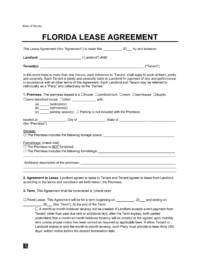
Florida Standard Lease Agreement
Enables a landlord and tenant to create a legally binding arrangement for renting a property.
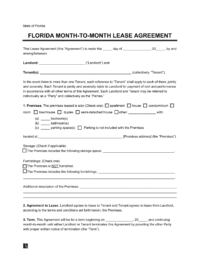
Florida Month-to-Month Rental Agreement
Enables tenants to occupy a property on a monthly basis, with no fixed long-term commitment.

Florida Commercial Lease Agreement
Enables a tenant to lease a property for business purposes.

Florida Room Rental Agreement
Sets the terms and conditions between tenants renting a room within a shared living space.
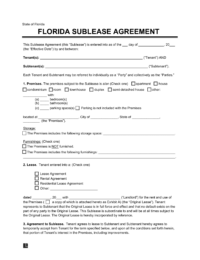
Florida Sublease Agreement
Allows the subtenant to rent all or part of the leased property for a specified period.
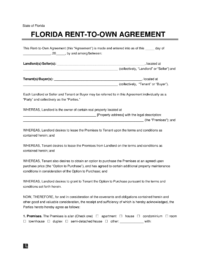
Florida Rent-to-Own Lease Agreement
Integrates the convenience of leasing with the promise of future ownership.
Florida Security Deposit Requirements
Florida law isn’t strict about some aspects of security deposits. For example, no statute limits the amount a landlord can charge for a security deposit, and state law doesn’t require landlords to issue security deposit receipts to tenants. However, all security deposits must be kept in a separate Florida institution’s bank account or surety bond and cannot be mixed with other funds (FL Stat. § 83.49(1)(a), (b)).
Florida landlords aren’t required to place a tenant’s security deposit in an interest-bearing account, but they can. If they do, the tenant must receive 75% of the interest earned on the account or 5% simple annual interest, whichever the landlord chooses (FL Stat. § 83.49(1)(b)).
At the end of a Florida residential lease agreement, the deposit must be returned to the tenant within 15 days if there are no deductions and within 30 days if there are deductions (FL Stat. § 83.49(3)(a)). Landlords can withhold a security deposit to cover unpaid rent, excessive property damage, specified fees, and lease violations.
Florida Rent Payment Rules and Late Fee Policies
Florida landlords can raise rent as much as they’d like, as no state statute imposes limits. Rent payments are due on the day mentioned in the lease; it’s usually the first day of the month, but the lease can specify otherwise.
Landlords in Florida can also charge as much as they deem fit for late rent, as there’s no state maximum. However, unreasonable fees may not be enforceable in court (FL Stat. § 83.45(1)). The landlord and tenant should agree on late fees in the lease before the situation arises.
Florida law does not offer a rent grace period. If rent is late, the landlord can send a 3-day notice to quit to start the eviction process (FL Stat. § 83.56(3)).
Tenants can withhold rent if the landlord fails to comply with applicable laws. Before withholding rent, tenants must give the landlord seven days’ written notice to address the issue (FL Stat. § 83.60).
Florida Landlord Entry Laws
Florida landlords must issue at least 24 hours’ notice before entering a tenant’s home to complete a repair (FL Stat. § 83.53(2)). They must enter between reasonable hours, which are between 7:30 AM and 8:00 PM. The landlord can also enter the premises for other reasons, like in an emergency or if the tenant unreasonably withholds consent.
Rental Property Maintenance Responsibilities in Florida
Landlords in Florida must ensure their rental units comply with building, housing, and health codes. If there are no applicable codes, they must keep all structural components in good repair and capable of resisting normal forces and the plumbing in reasonable working condition (FL Stat. § 83.51).
Tenants have similar responsibilities. They must maintain fixtures and appliances, operate facilities reasonably, and keep the property clean and compliant with applicable codes (FL Stat. § 83.52).
How to Legally Terminate a Lease in Florida
In Florida, to terminate a monthly tenancy, a 30-day notice is required (FL Stat. § 83.57(2)and(3)).
If the tenant leaves their belongings behind, the landlord must issue notice about them and any associated fees. If the belongings are delivered in person, the claim period is 10 days, or 15 days if mailed (FL Stat. § 715.104). If the landlord reasonably valued the items over $500, unclaimed items must be sold at auction; otherwise, they can be kept or discarded (FL Stat. § 715.109).
Sample Florida Lease Agreement
View our free Florida lease agreement template below. Create your own using our guided form so you can solidify a landlord-tenant relationship. Downloadable in PDF and Word format.





