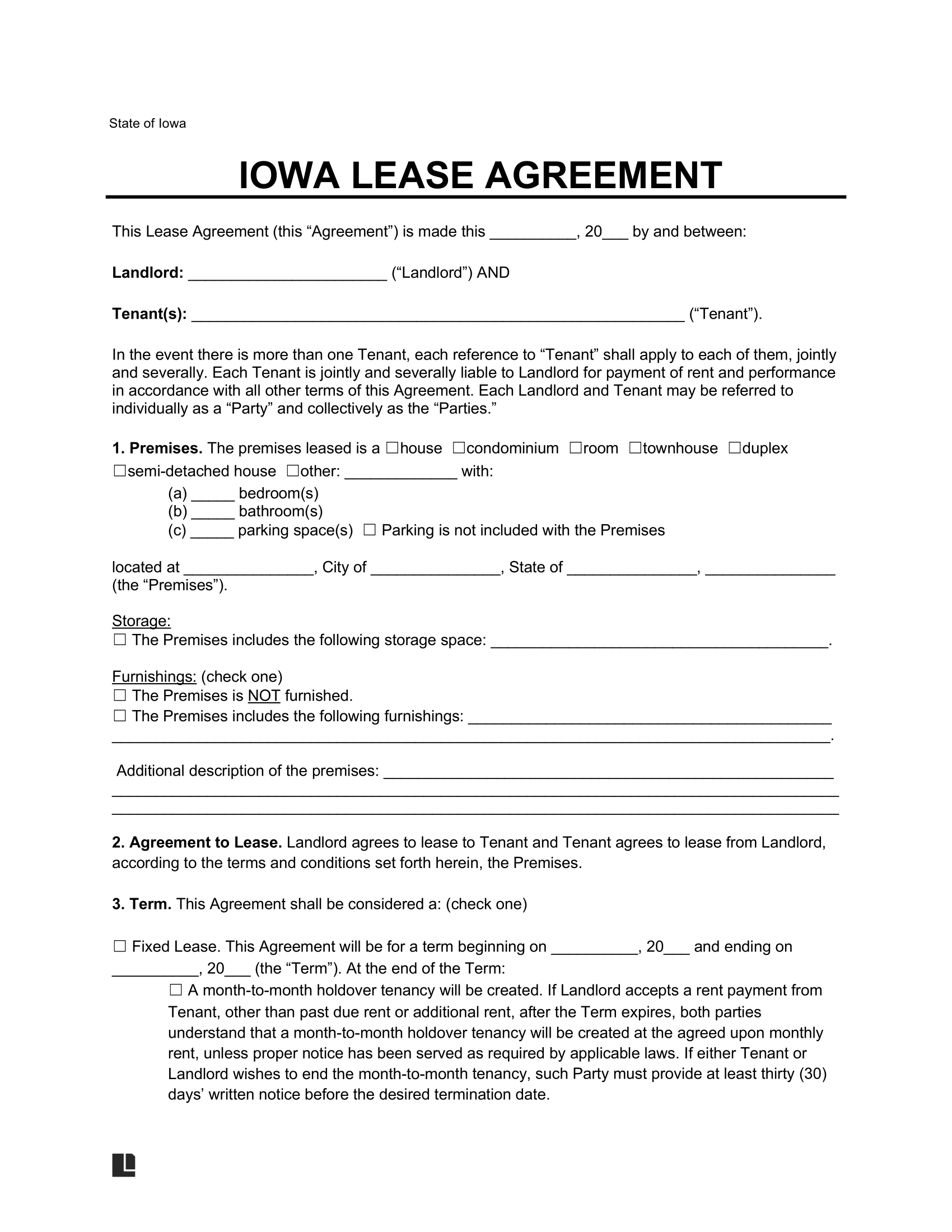
What Is an Iowa Lease Agreement
An Iowa lease agreement is a written contract between a landlord and a tenant. It outlines the terms for renting a residential property. This document lists key details that both parties agree upon, including the rent amount, security deposit, lease term, utility responsibilities, and any applicable house rules.
The Uniform Residential Landlord and Tenants Act governs most residential leases in Iowa, found in Iowa Code Chapter 562A. This law protects both parties by setting standards for how things will be handled during the lease term, such as repairs, deposits, notice of entry, and when and how a lease can end.
In Iowa, a rental lease agreement can be for any length of time as long as the terms are clearly stated in writing and agreed upon by both the landlord and tenant. If the lease is oral, it’s only valid for up to one year in Iowa. Usually, if a lease doesn’t specify a term, it defaults on how rent is paid:
- Week-to-week, if rent is paid weekly
- Month-to-month in all other cases (Iowa Code § 562A.9)
Landlords in Iowa can ask potential tenants to complete a rental application form before offering a lease. This helps verify income, rental history, and other important details.
Iowa Landlord‑Tenant Laws Overview
| Topic | Rule | Iowa Law |
|---|---|---|
| Rent Control | Iowa does not allow local rent control ordinances | Uniform Residential Landlord and Tenant Law |
| Grace Period for Rent | No grace period is required by state law | No law |
| Maximum Late Fee | Up to $12/day (max $60/ month) if rent is $700 or less, and up to $20/day (max $100/month) if rent is over $700 | Iowa Code § 562A.9(4) |
| NSF Fee | May not exceed $30 | Iowa Code § 554.3512 |
| Security Deposit Limit | Cannot exceed two months' rent | Iowa Code § 562A.12(1) |
| Security Deposit Return | Must return within 30 days after the lease ends and the tenant moves out | Iowa Code § 562A.12(3) |
| Landlord Entry Notice | Give at least 24 hours' notice before entering, except in emergencies | Iowa Code § 562A.19(3) |
| Repairs and Habitability | Landlords must maintain the property in a safe and livable condition, including ensuring working plumbing and heat. | Iowa Code § 562A.15 |
| Tenant Maintenance Duties | Tenants must keep the unit clean and not damage the property. | Iowa Code § 562A.17 |
| Owner/ Manager Identification | Landlords must provide the name and address of the property manager or owner. | Iowa Code § 562A.13 |
| Abandonment of Personal Property | Landlords must follow legal steps before disposing of items left behind | Iowa Code § 562A.29B |
Iowa Security Deposit Laws
Landlords in Iowa can collect a security deposit from tenants, but state law limits how much they can charge and outlines clear instructions on how that money should be handled under Iowa Code § 562A.12.
Maximum Amount
Landlords can charge up to two months’ rent as a security deposit. There is no requirement to provide a receipt.
Interest Payments
Landlords are not required to place the deposit in an interest-bearing account. If they choose to, any interest earned in the first five years belongs to the landlords. After that, interest must be credited to the tenant.
Holding the Deposit
Security deposits must be held in a separate account from the landlord’s personal funds. They can be placed in a trust account or held in a federally insured bank account.
Return Requirements
Landlords must return the full deposit, or any remaining amount after deductions, within 30 days after the lease ends and the tenant moves out.
Itemized List of Deductions
If the landlord keeps any part of the deposit, they must provide a written statement explaining these deductions. This includes a list of damages beyond normal wear and tear (Iowa Code § 562A.12(3)).
Withholding Rules
A landlord cannot withhold any part of the deposit without giving the tenant a written explanation. If they fail to do this within the 30-day deadline, the tenant may be entitled to a full refund of the deposit.
Iowa Rent Rules and Payment Terms
Iowa landlords can set rent prices freely, as the state does not have rent control. However, rent changes during a lease term are only permitted if the lease includes a clause that allows for adjustments.
Rent Due Date and Grace Period
Rent is due on the date specified in the lease. Iowa does not require a grace period either, so if the lease doesn’t allow one, late fees may apply immediately (Iowa Code § 562A.9).
Late Fees
If the rent is $700 or less per month, landlords can charge up to $12 per day, with a maximum of $60 per month. For rent over $700, the fee can be up to $20 per day, with a maximum limit of $100 per month (Iowa Code § 562A.9(4)).
NSF/ Bounced Check Fee
Landlords in Iowa can charge up to $30 for a bounced check, also known as a non-sufficient funds (NSF) fee. This must be clearly stated in the lease or prominently displayed where rent is typically paid, such as on the online payment page (Iowa Code § 554.3512).
Rent Increase
Landlords can raise the rent after a lease ends, but they must give the tenant proper notice. During an active lease, rent can only increase if the lease specifically allows it. Iowa does not set a statewide limit on how much rent can increase (Iowa Code § 562A.9).
Withholding Rent
If a landlord fails to provide essential services such as heat, water, or electricity, the tenant can give written notice and withhold rent, recover damages, or deduct repair costs. The issue must be significant, and the landlord must be given time to fix it (Iowa Code § 562A.27).
Note that Iowa has separate rules for mobile home leases under Iowa Code Chapter 562B. These cover issues such as rent increases, evictions, and home sales.
Landlord’s Right to Enter in Iowa
Landlords in Iowa can enter a rental unit, but they must follow specific rules regarding notice and timing, unless there’s an emergency.
General Entry and Notice Requirements
Landlords in Iowa are required to provide tenants with at least 24 hours’ notice before entering the property. They should only enter at reasonable times, usually during daylight hours. The entry must be for valid reasons, such as making repairs, inspections, or showing the property to future renters or buyers (Iowa Code § 562A.19(3)).
Keys, Locks, and Security
Iowa law doesn’t specifically restrict tenants from changing locks, but it’s best to get written permission from the landlord before doing so. Including the terms about who holds the keys and how locks can be changed within the lease agreement is a good idea, as that can help prevent disagreements later.
Emergency Access
In the event of an emergency, such as a fire, flood, or gas leak, the landlord may enter the unit without providing prior notice. Emergencies are the only exceptions to the 24-hour rule (Iowa Code § 562A.19(3)).
Iowa Property Repair and Habitability Laws
Landlords and tenants both have specific responsibilities under Iowa law to maintain the rental property in a safe and livable condition.
Landlord Responsibilities
Landlords must keep the rental unit in good repair and ensure it meets basic health and safety standards. This includes providing and maintaining:
- Working plumbing and running water
- Functioning heating and electrical systems
- Sanitary facilities
- Pest-free living conditions
Landlords are also responsible for making timely repairs when issues arise (Iowa Code § 562A.15).
Tenant Responsibilities
Tenants are responsible for keeping their rental unit clean and undamaged. They are expected to take care of all the fixtures and appliances that come with the rental unit. If the tenant or their guests cause damage, the tenant is responsible for the repairs (Iowa Code § 562A.17).
Abandonment
If a tenant is gone from the property for more than 14 days, the landlord may enter the unit for inspection, maintenance, or to protect the property. If it’s clear that the tenant has abandoned the unit, the landlord must attempt to re-rent it at a reasonable market rent. They cannot set the price unusually high just to charge the former tenant more. The lease ends once a new tenant moves in or the landlord formally recognizes the abandonment (Iowa Code § 562A.29).
Iowa Lease Agreements By Type
Iowa landlords and tenants can use different lease forms depending on the type of rental property and the duration of the lease. The templates below can be tailored to your specific situation, allowing you to create an agreement that clearly reflects your terms and adheres to Iowa law.
Iowa Standard Lease Agreement
Creates a tenancy arrangement between a landlord and a tenant for renting residential property.
Iowa Month-to-Month Rental Agreement
Use to allow residents to choose to inhabit a property on a flexible, month-to-month basis, without being tied to a long-term commitment.
Iowa Commercial Lease Agreement
Establishes the terms and conditions for the rental of commercial property.
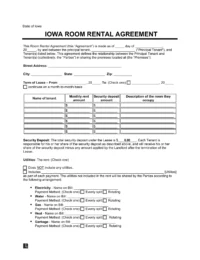
Iowa Room Rental Agreement
Defines the rules and regulations for tenants sharing a residence.
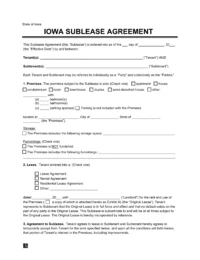
Iowa Sublease Agreement
Grant the subtenant the authority to rent either the entire or a portion of the leased property for a specified period.
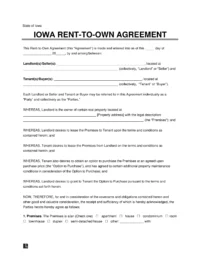
Iowa Rent-to-Own Lease Agreement
Grants tenants the exclusive option to purchase the property before the lease concludes.
Required Lease Disclosures in Iowa
Before the lease officially begins, landlords in Iowa are required to share certain information with tenants. These disclosures ensure tenants understand who manages the property, how utilities are billed, and whether any known hazards affect the home.
Lead-Based Paint Disclosure
From homes built before 1978, federal law required landlords to inform tenants about any known lead-based paint hazards. Landlords must also provide the EPA’s lead safety pamphlet (42 US Code § 4852d).
You can use a lead-based paint disclosure form to document that this information was shared before the lease begins. It helps protect both the landlord and the tenant, keeping the rental agreement compliant.
Owner or Manager Identification
Landlords must disclose the names and addresses of the property owner or any other person authorized to manage or accept notices on behalf of the rental property. This information must be included in the written lease agreement (Iowa Code § 562A.13(1)).
Shared Utilities Disclosure
If the rental shares utilities with another unit or space, the landlord must explain how charges will be divided before the lease begins. This helps tenants understand whether they pay a flat rate, a percentage, or usage measured by a shared meter (Iowa Code § 562A.13(4)).
If you’re unsure how utility costs should be divided in a rental, you can read our guide on who pays utilities when renting to understand common setups and what to expect.
Environmental Hazard Disclosure (CERCLA)
If the property is located on or near a hazardous site listed under the federal Comprehensive Environmental Response, Compensation, and Liability Act (CERCLA), the landlord should inform the tenant of any known risks associated with the site. This includes properties listed in the EPA’s Superfund database.
Sample Iowa Lease Agreement
Review our sample Iowa lease agreement to see how rental terms are typically outlined. When you’re ready, use our guided questionnaire to create a personalized agreement and download it in PDF or Word.
Prohibited Lease Clauses in Iowa
Iowa law does not allow specific terms in residential leases. These clauses are considered unfair and cannot be enforced, even if both parties sign the agreement.
- Waive Legal Rights: An Iowa residential lease agreement cannot ask a tenant to give up rights or protections provided under Iowa law (Iowa Code § 562A.11(1)(a)).
- Confessing Judgment: Landlords cannot include a clause that makes the tenant automatically lose a legal dispute without a chance to appear in court (Iowa Code § 562A.11(1)(b)).
- Paying the Other Party’s Legal Fees: A lease cannot require a tenant to pay the landlord’s attorney fees simply because a disagreement arises (Iowa Code § 562A.11(1)(c)).
- Limited Liability: Landlords cannot use a lease to avoid responsibility for injuries, property damage, or other issues caused by their own actions (Iowa Code § 562A.11(1)(d)).
Even if you sign a lease with one of these illegal clauses, it’s not enforceable under Iowa law. If a landlord knowingly includes a prohibited term, you may be entitled to actual damages, up to three months’ rent, and attorney’s fees, under Iowa Code § 562A.11(2).