What Is a Delaware Quitclaim Deed?
A Delaware quitclaim deed is a form used to change ownership rights of a property from one individual to another. This type of deed does not offer a warranty or guarantee for the property’s title. Typically, a quitclaim deed transfers ownership in a divorce or between family members. You may also use it to correct title information or fund a revocable living trust.
Legal Templates offers free Delaware quitclaim deed forms to ensure a valid property transfer. Use our form to record important information about the change of ownership.
What to Include in a Delaware Quitclaim Deed
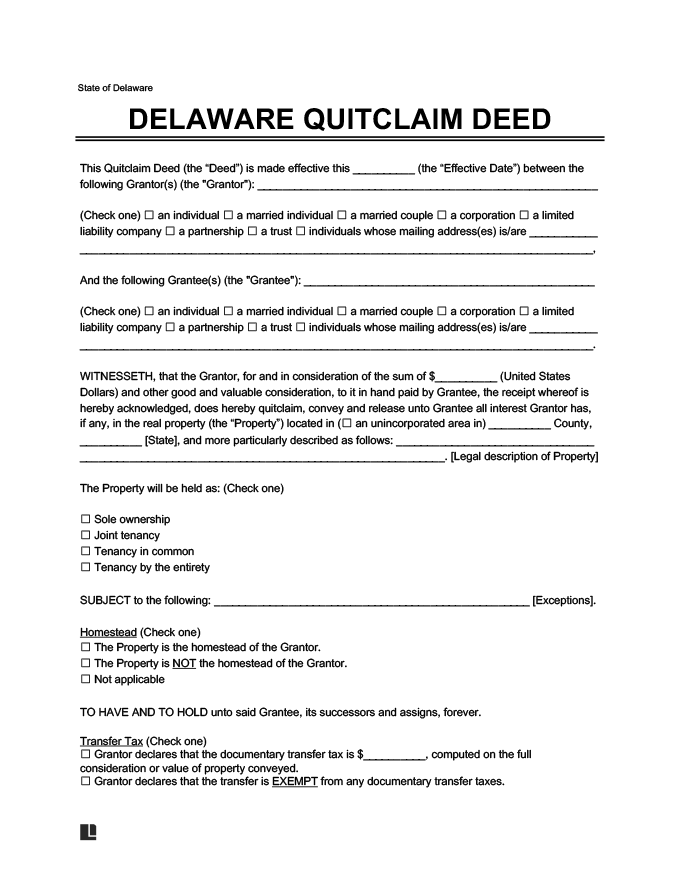
The content of your deed must accurately reflect the people, property, laws, and terms involved. Include the following information for a valid Delaware quitclaim deed:
- Party information: Provide the name and address for both the grantor and grantee. Clearly indicate each party’s involvement in the transaction.
- Property description: Include a full legal description of the property. Note its location, county, metes and bounds, and lot number.
- Quitclaim terms: Under 25 DE Code § 121, a quitclaim deed must contain the word “quitclaim” to note the lack of guarantee and distinguish it from a warranty deed.
- Statement of consideration: If the grantee paid for the ownership rights, the deed must have a statement of consideration. This statement typically includes a nominal amount, such as $10, to show that a payment was made without revealing the total.
- Signature and notarization: Per 25 DE Code § 122, a valid quitclaim deed requires the grantor’s signature, as well as those of a witness and a notary.
- Form 5402: The Realty Transfer Tax Return and Affidavit of Gain and Value (Form 5402) is necessary for validating and completing a property transfer in Delaware. File this form in addition to the deed.
Sample Delaware Quitclaim Deed
Legal Templates’s free Delaware quitclaim deed form includes state-specific terms and formatting. Customize and then download in PDF or Word format for a compliant transfer of real estate ownership.
How Much Does a Delaware Quitclaim Deed Cost?
The final cost of a Delaware quitclaim deed varies depending on the property’s location, value, and history. Consider the filing fees and various tax costs to determine the exact cost of your deed.
Filing Fees
Each of the three counties in Delaware assesses its own quitclaim deed filing fees. Contact and file your forms with the Recorder of Deeds and pay the corresponding costs in the following counties:
- Kent County: $36 per document, $10 per page, and $5 per tax parcel number
- New Castle County: $13 per page and $3 parcel description fee. The county also assesses a $30 document fee and a $5 technology fee per document.
- Sussex County: $30 document fee, $9 per page, and a $1 maintenance fee per document.
Transfer Taxes
Under 30 DE Code § 54, a transfer tax applies to quitclaim deeds. At the state level, the tax rate is 3%, unless the property’s county charges a rate of more than 1%, in which case the state rate will be 2.5%. Each county also reserves the right to assess taxes at a rate between 1% and 1.5%. In Delaware, transfer tax costs are split evenly between the grantor and grantee at the time of sale.
Gift Taxes
If the quitclaim transfer works to gift the property to another individual, the federal gift tax may apply. The IRS assesses the gift tax on any gifted property value that exceeds the gift limit of $19,000 for the 2025 tax year. Determine and file your gift tax payment with Form 709.
Capital Gains Taxes
When a property is sold or transferred for significantly more than the original purchase price, capital gains tax may apply. The federal capital gains tax ranges from 0% to 15%, or 20% for long-term holdings (more than a year), depending on your taxable income and the profit from your quitclaim transfer.
In addition, Delaware has its own state-level capital gains tax, as defined in 30 DE Code § 11. These taxes are applied with the state’s annual income taxes, which range from 2.2% to 6.6% depending on your tax bracket and income.