What Is a Quitclaim Deed in Louisiana?
A Louisiana quitclaim deed is a legal document used to transfer an ownership interest in real estate from one person to another. This document only transfers whatever ownership rights the current owner has, if any. It does not guarantee clear ownership. That is why it is most commonly used between family members or people who know and trust each other.
Louisiana law requires that all transfers of immovable property be made in writing to be legally effective (Louisiana Civil Code Article 1839). Read our guide on the different types of deeds and when to use each one if you want to determine whether a quitclaim deed is the right document for your needs.
Requirements for a Quitclaim Deed in Louisiana
To be valid in Louisiana, a quitclaim deed form must follow certain rules and formatting standards before it can be recorded. Here are some key things to consider:
Required Information
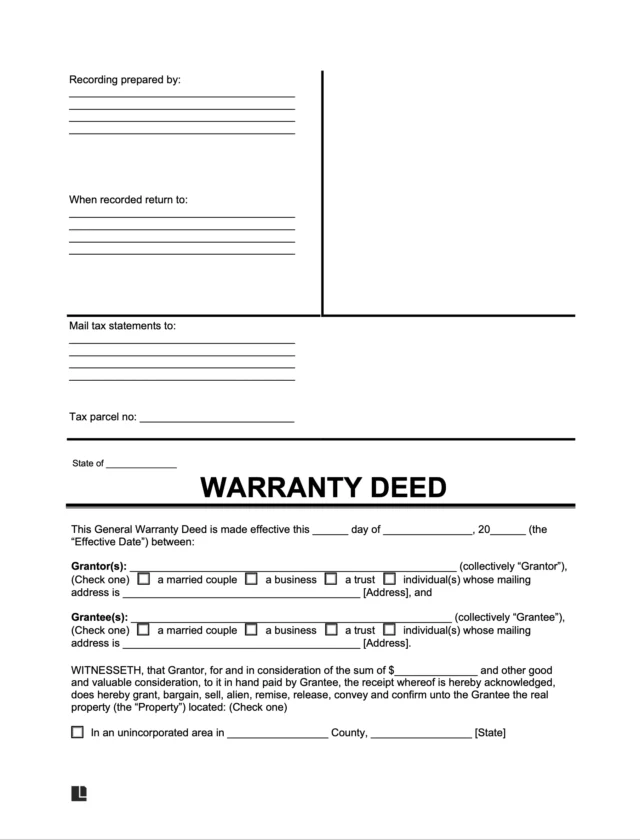
You must clearly identify the people involved and the property being transferred on your quitclaim deed form. Missing information can lead to the deed being rejected. Include:
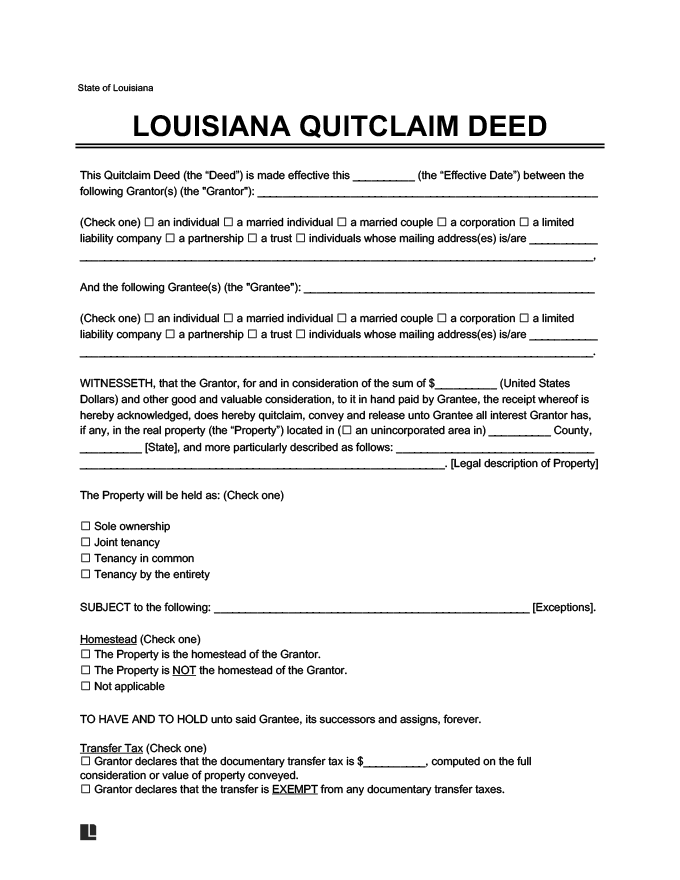
- The full legal names and mailing addresses of the grantor, who is giving up their ownership interest.
- The full legal name and mailing address of the grantee, who is receiving the property.
- A legal description of the property, taken from a prior recorded deed. Do not rely solely on the street address. Include the official description used in property records.
- The consideration or value exchanged for the transfer, even if it is a small amount or is a gift.
Signing Requirements
Under the Louisiana Civil Code Article 1833, the quitclaim deed form must be signed by the grantor in the presence of a notary public and two witnesses. The notary and the two witnesses must also sign the deed. When the document is signed this way, it is considered an authentic act under Louisiana law. The grantee does not need to sign the deed for it to be valid.
Formatting Rules
As per Louisiana Revised Statutes § 13:844, the deed should be legible and easy to understand. While Louisiana may accept deeds that do not follow every formatting guideline, clerks often reject documents that are difficult to process. So it is important to ensure that your document follows the general formatting requirements, such as:
- Include a clear title on the first page, such as “Quitclaim Deed.”
- Leave a 2-inch blank margin at the top of the first page.
- Leave a 1-inch margin on the sides and bottom of the first page.
- Use a font size of at least 8-point so the text is easy to read.
- Print the document on 8.5 x 11 or 8.5 x 14 paper.
If you use any other paper, you may be charged an additional $20 fee per page.
Property Disclosure Rule
Sellers may be required to disclose known defects or adverse conditions affecting the property. In some cases, they may have to include a property disclosure statement when transferring residential property. This requirement depends on the type of property and the nature of the transfer (Louisiana Revised Statutes § 9:3198).
Sample Louisiana Quitclaim Deed
You can view a sample Louisiana quitclaim deed form below to see what details are typically included on the document. Then use Legal Templates’s guided questionnaire to fill out yours and download your deed as a PDF or Word file.
How to Submit a Quitclaim Deed in Louisiana
Once your quitclaim deed is prepared, follow these steps to submit it for recording.
Step 1 – Get a Copy of the Previous Deed
Start by getting a copy of the most recent recorded deed for the property. You can usually find it through the parish clerk of court’s website or by visiting the clerk’s office in person. The previous deed will also include the official legal description of the property, which must be copied as is.
Step 2 – Complete the Louisiana Quitclaim Deed Form
Fill out your quitclaim deed form carefully. Make sure you fill out all the required fields. To speed up the process, you can use Legal Templates’s free Louisiana quitclaim deed form to get started. Our step-by-step questionnaire helps you complete the form quickly and correctly.
Step 3 – Sign Before a Notary
After completing the deed, sign it in the presence of a notary and two witnesses. Bring a valid government-issued ID to the signing.
Step 4 – Record With the Parish Clerk of Court
Submit the signed deed to the clerk of court in the parish where the property is located and pay any recording fees. Recording the quitclaim deed in Louisiana is important because the transfer does not fully protect the new owner until it is filed with the parish clerk (Louisiana Civil Code Article 517).
How Long Is a Quitclaim Deed Valid for in Louisiana?
A Louisiana quitclaim deed form does not expire once it is properly signed and recorded. There is no time limit or renewal requirement. The deed becomes valid upon signing.
How Much Does it Cost to Submit a Louisiana Quitclaim Deed?
There are certain recording fees charged by the parish clerk of court in Louisiana.
Recording Fees
Under the Louisiana Revised Statutes § 13:844(A)(1), the recording fees for a quitclaim deed in Louisiana can vary based on the length of the document. Here’s a breakdown:
- $100 for documents that are 1 to 5 pages
- $200 for documents that are 6 to 25 pages
- $300 for documents that are 26 to 50 pages
- $300 for the first 50 pages, plus an additional $5 for each extra page over 50
These fees include recording the document, listing up to 10 names in the public record, and providing one certified copy.
Taxes
Louisiana does not charge a state real estate transfer tax when property is transferred using a quitclaim deed form. With that said, however, some federal taxes may still apply depending on the situation. For example, a gift tax may apply if the property is being transferred without any payment. A capital gains tax may apply if the property has increased in value and is later sold.