What Is a Nevada Quitclaim Deed?
A Nevada quitclaim deed is a form that transfers your current ownership of a property, not promising the absence of claims or liens. While it doesn’t guarantee a valid title (NV Admin Code § 375.100), it’s a convenient way to transfer ownership from the grantor to the grantee. It’s best to use it in scenarios where the parties already trust each other. For example, you may use this document to add a spouse or edit property ownership during a divorce.
A Nevada quitclaim deed permanently transfers any ownership interest the grantor may have. The grantee should record the deed as soon as possible to ensure the transfer goes on the public record. The deed may be legally challenged in cases of fraud or duress.
What to Include in a Nevada Quitclaim Deed
NV Rev Stat § 111.312 requires that most deeds, including quitclaim deeds, contain the following information:
- The grantee’s mailing address
- The assessor’s parcel number of the property at the top left corner of the deed’s first page (not required if the deed exclusively transfers water rights)
- The name and mailing address of the person who should receive the property tax statement
- Legal description of the property (the assessor’s parcel number cannot serve as the full legal description)
- The name and address of the person who prepared the legal description (if the legal description is in metes and bounds)
Other key information to add to your NV quitclaim deed includes the following:
- Statement of conveyance (must use “quitclaim and release,” as NV Rev Stat § 111.170 states that the use of the words “grant,” “bargain,” or “sell” can be construed as guarantees of the title’s condition)
- Consideration paid for the property (or a nominal amount if it was a gift)
- Grantor’s name and mailing address
Nevada Quitclaim Deed Sample
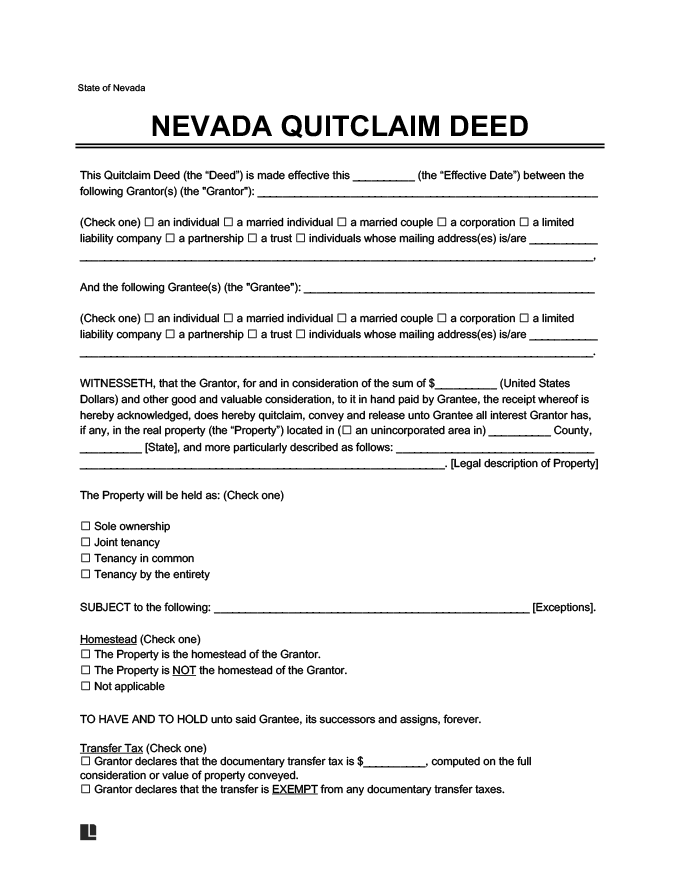
View an example of a Nevada quitclaim deed to better understand how to write your own. Then, use Legal Templates’s guided questionnaire to create yours online. Download it in PDF or Word format.
Formatting Requirements for a Nevada Quitclaim Deed
Nevada quitclaim deed laws are very specific when it comes to formatting. State document requirements, including those for quitclaim deeds, are listed under NV Rev Stat § 247.110. To be valid, your deed should:
- Be printed on white 20-pound paper, 8 ½ in. by 11 in.
- Have 1 in. margins on both sides and the bottom of each page
- Have a 3 in. by 3 in. space at the top right of the first page
- Have 1 in. margins on the top of every subsequent page
- Be unbound on the top, sides, and bottom
- Not have documents physically attached to the document
- Be printed on only one side of each page
- Be typed in 10-point Times New Roman text or larger
- Not include colored markings or highlighting on the document
- Not include a seal or stamp that covers text or signature in the document
Your county recorder may have additional requirements for form submission. Check with your county recorder’s office before submitting your documents to be sure you meet all the requirements.
How to File a Nevada Quitclaim Deed
Filing a quitclaim deed in Nevada involves preparing the form, getting it notarized, and recording it with the county recorder. Following the full process ensures the transfer is legally binding.
Step 1 – Procure the Original Property Deed
The original property deed has important information you need to file your quitclaim deed, including the owner’s name, legal property description, and assessor’s parcel number. If you do not have the property deed, contact the county recorder’s office in the county where the property is located.
Step 2 – Fill out the Nevada Quitclaim Deed Form
Download a fillable Nevada quitclaim deed form, like the one from Legal Templates. You can use the form to meet formatting and content requirements without having to start from scratch. Enter details about the property transfer in accordance with NV Rev Stat § 247.110.
Per NV Rev Stat § 239B.030, personal information such as Social Security numbers should be redacted unless they are specifically required by statute.
Step 3 – Sign Before a Notary
According to NV Rev Stat § 111.105, the quitclaim deed must be signed by the property owner, or grantor. This includes both spouses if the property is co-owned by a married couple, per NV Rev Stat § 123.230. Every signature on the quitclaim deed must have the signer’s name printed or typed underneath the original signature, per NV Rev Stat § 247.190.
The signatures must be notarized, consistent with NV Rev Stat §§ 111.240, 240.161, and 240.169. NV Rev Stat §§ 240.1655, 240.166, and 111.310 provide further guidance for notarizing real estate documents, including certification, stamp requirements, and acknowledgment language.
Step 4 – Complete the Declaration of Value Form
Complete a Declaration of Value Form, per NV Rev Stat § 375.060. The linked form is for use in Washoe County, but you can request the right form to use from your county recorder’s office.
Step 5 – File the Deed With the County Recorder’s Office
Submit your Nevada quitclaim deed to the county recorder’s office in the county where the property is located, per NV Rev Stat § 111.312. You can find a list of all county recorders in Nevada on the Nevada Secretary of State website.
How Much Does a Nevada Quitclaim Deed Cost?
Filing a Nevada quitclaim deed comes with a few associated costs, including recording fees, transfer tax, gift tax, and capital gains tax.
Recording Fees
Recording fees are established by NV Rev Stat § 247.305. However, the law allows each county to determine which fees to charge for recording a deed. The only required fee per Nevada statute is a $25 fee for recording the document. Check with your county recorder’s office to learn which other fees may apply. For example, Washoe County charges $43 per document, while Clark County charges $42 per document.
Taxes
In addition to recording fees, a property transfer via a quitclaim deed in Nevada may be subject to transfer taxes, US gift tax, and capital gains taxes.
1. Transfer Tax
Per NV Rev Stat § 375, transfer taxes are imposed on real estate transfers based on the county’s population and the property’s value.
Who Pays the Transfer Tax?
Both the grantor and grantee are liable for ensuring the transfer tax is paid. Typically, transfers involve an agreement between the parties as to who will handle the transfer tax.
Exemptions to Transfer Tax
NV Rev Stat § 375.090 lists numerous exemptions to the transfer tax. Exemptions that could apply to a Nevada quitclaim deed include:
- Change of business identity or transfer between a company and a subsidiary or affiliate
- Transfer to the US or any agency, department, instrumentality, or political subdivision thereof
- Transfer for a land sale contract or other recognition of true ownership status
- Transfer to a co-owner without financial consideration
- Transfer to a close relative
- Transfer to an ex-spouse due to a divorce decree
- Transfer to or from a trust without consideration with a certificate of trust
- Transfer to a business fully owned by the property owner
- Transfer upon the death of the grantor with a Death of Grantor Affidavit
- Transfer to an educational, university, or library foundation
- Transfer of property for bankruptcy, reorganization, or adjustment
Certain rules and regulations apply to exemptions, and not all exemptions are listed above. If you are not sure whether your Nevada quitclaim is exempt from transfer tax, speak with a tax professional or attorney familiar with real estate transactions in your county.
Tax Rates
Per NV Rev Stat § 375.020, counties with populations greater than 700,000 are subject to a transfer tax of $1.25 per $500 of property value. Property transfers in counties with populations below 700,000 are subject to a tax of $0.65 per $500.
2. Federal Gift Tax (Form 709)
Nevada does not charge a gift tax, but the US government does for gifts over a certain value. The Internal Revenue Service (IRS) updates the exemption limit annually, so check its website for the latest information before filing your income taxes for the year.
3. Capital Gains Tax
Nevada does not charge a capital gains tax. Individuals who make over a certain amount from a quitclaim real estate transfer may still be subject to capital gains tax on a federal level. Review capital gains tax information on the IRS website to learn how to calculate and file capital gains tax for property transferred via a quitclaim deed in Nevada.