What Is a Utah Quitclaim Deed?
A Utah quitclaim deed is a legal form used to transfer ownership interest in a property from one person to another. Under Utah Code § 57-1-13, a quitclaim deed transfers the grantor’s interest in the property but does not guarantee that the title is clear. This means that:
- The grantor does not promise full ownership of the property
- The grantor does not guarantee the property is free of liens
- The grantee receives only the interest the grantor actually holds
This is why quitclaim deed forms are typically used between people who already know and trust each other, such as family members or spouses.
Utah Quitclaim Deed Requirements
Follow the requirements below to make sure your quitclaim deed form is recorded without delays or rejections by the county recorder.
Information to Include
A Utah quitclaim deed form should clearly identify the parties and the property being transferred. Your deed should include:
- The full legal names of the grantor and grantee
- The mailing address of each party
- The consideration, if any, being paid for the transfer
- The date of the transfer
- The complete legal description of the property
As per Utah Code § 57-3-105, the legal description of the property must match the description listed on the most recently recorded deed. A street address is not enough. Here’s what a complete legal description of the property may consist of:
- Metes and bounds
- A reference to the Public Land Survey System, including township, range, and meridian
- A lot, block, tract, parcel, or unit within a recorded subdivision plat
- The claim name and the state/federal agency serial number (if available), if the real property consists of a mining claim
Formatting Requirements
County recorders will reject documents that do not meet Utah’s formatting standards. According to Utah Code § 17-21-20, here are the formatting requirements your form must follow:
- Be an original document or a certified copy
- Be in English or include a certified English translation
- Contain original signatures
- Show a clear and legible notary seal
- Be printed on white paper,8.5 by 11 inches
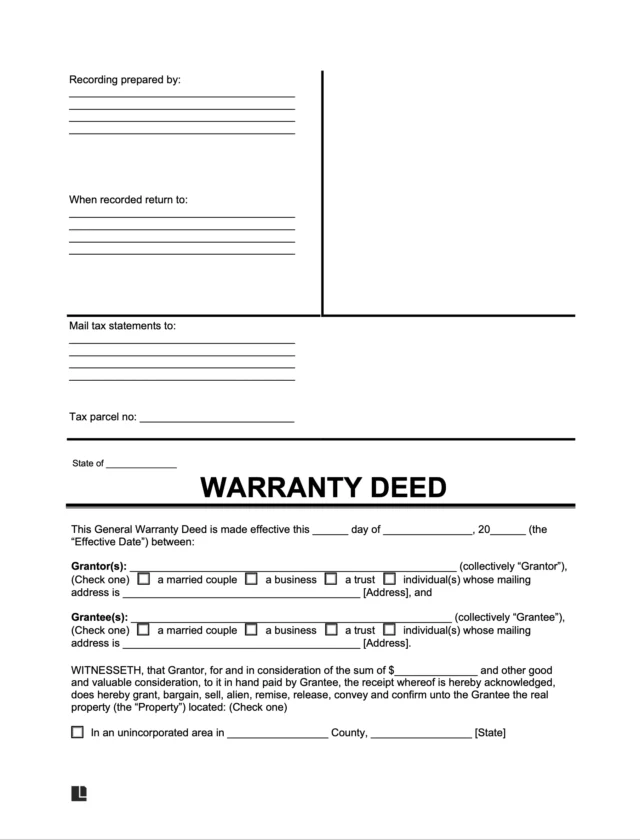
- Include a 4.5-inch by 2.5-inch blank space in the upper right corner of the first page
- Have a one-inch top margin on each additional page
- Be legible and suitable for copying
- Be printed in black ink
Signing and Notarization
The grantor must sign the quitclaim deed in the presence of a notary public. The notary verifies the grantor’s identity and confirms the signature. Remember to bring a valid form of identification to the notary (Utah Code § 46-1-2).
Without notarization, the county recorder will not accept the deed for recording (Utah Code § 57-3-101). The Utah State Notary Office offers an online search for notaries in your zip code.
Notaries in Utah sometimes charge a small fee to notarize documents. Under Utah Code § 46-1-12, notaries can charge up to $10 per signature for in-person notarization and $25 per signature for remote notarization.
Utah Water Rights Addendum
Utah requires an additional form when recording most deeds. You will need to submit a Water Rights Addendum along with your quitclaim deed form (Utah Code § 57-3-109). This document discloses whether water rights are included in the transfer. Even if you’re not transferring water rights, you must still complete the addendum as a confirmation. Failing to include this addendum may delay recording.
Sample Utah Quitclaim Deed
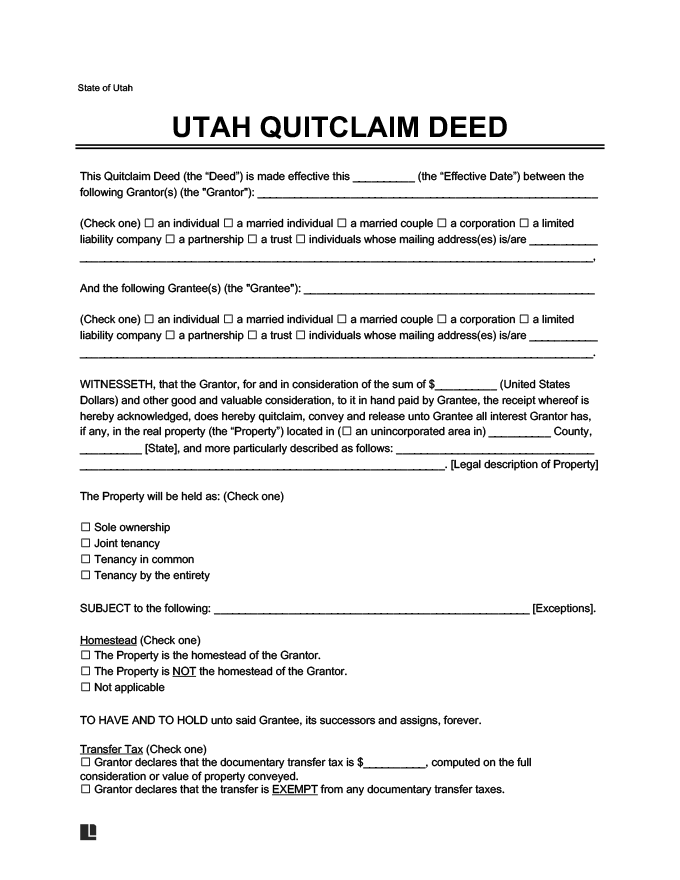
View a sample Utah quitclaim deed form below to see all the details you’d need to include. When you’re ready, use Legal Templates’s step-by-step questionnaire to create your own. Download your completed free quitclaim deed form in PDF or Word format.
How to File a Quitclaim Deed in Utah?
Here’s a step-by-step guide on how to file a quitclaim deed in Utah.
Step 1 – Get the Prior Deed
Before filling out your quitclaim deed, find the most recently recorded deed for the property. You will need this previously recorded deed to copy the exact legal description of the property and confirm other details. If you do not have a copy, you can request one from the county recorder’s office where the property is located.
Step 2 – Fill Out the Utah Quitclaim Deed Form
Complete your Utah quitclaim deed form with all the required information. You must also complete the Water Rights Addendum required by Utah law. This addendum must be submitted with your quitclaim deed, even if no water rights are being transferred.
Step 3 – Sign and Notarize the Deed
A Utah quitclaim deed form must be signed by the grantor in front of the notary public. The notary should properly acknowledge the signatures and verify the grantor’s identity, and confirm the signature.
Step 4 – Record the Deed
After signing, record the deed with the county recorder’s office in the county where the property is located. Recording the deed makes the transfer part of the public record and protects the grantee’s interest in the property.
How Much Does It Cost to File a Quitclaim Deed in Utah?
There are certain recording fees that you may be required to pay when recording your Utah quitclaim deed form.
Utah charges a flat fee to record a deed. The recording fees are as follows:
- $40 per instrument, with no page limit
- $2 for each legal description beyond the first ten (Utah Code § 17-21-18.5)
Utah does not charge a state real estate transfer tax when property is conveyed. This means you will not owe a state-level transfer tax when you file a quitclaim deed. However, federal taxes may still apply, depending on how the property is transferred. For example, a gift may require federal gift tax reporting, and a sale could result in federal capital gains tax.