What Is a Transfer on Death (TOD) Deed?
A transfer on death deed, also known as a beneficiary deed, is a legal document that lets you pass your property to someone upon your death without going through probate. You can name a person or an organization, like a charity, as the beneficiary. If that beneficiary dies before you, you can list a backup.
With this type of deed, you keep full control of the property until your death. The beneficiary has no rights to it while you’re alive. When you pass away, the property automatically transfers according to the TOD deed, once the beneficiary provides an affidavit of death and a death certificate to the county recorder.
Pros of a Transfer on Death Deed
- Simpler setup than a living trust
- Avoids probate
- Allows the owner to retain control
- Preserves state-level asset protection and tax benefits
- Reduces potential capital gains tax because of the stepped-up basis for beneficiaries
Which States Allow Transfer on Death Deeds?
As of February 2026, 31 states and Washington, DC, allow transfer on death deeds for real estate. You must follow state-specific requirements for your TOD deed, as each state has its own laws guiding its creation. For example, a transfer on death deed in Texas will look different from a transfer on death deed in California.
Since each state has its own process, it’s important to double-check the details before filing. Here are the states where transfer on death deeds are currently allowed and the statutes that govern them.
| State | Governing Statute | State-Specific Title |
|---|---|---|
| Alaska | AK Stat § 13.48.120 | Transfer on Death Deed |
| Arizona | AZ Rev Stat § 33-405 | Beneficiary Deed |
| Arkansas | AR Code § 18-12-608 | Beneficiary Deed |
| California | CA Prob Code § 5696 | Revocable Transfer on Death (TOD) Deed |
| Colorado | CO Rev Stat §§ 15-15-401 — 15-15-415 | Beneficiary Deed |
How to Fill Out a Transfer on Death Deed
A transfer on death deed form has to be filled out with care. Inputting accurate details can ensure your county accepts it and help the transfer hold up later. Here’s how to complete each part properly so your plans to pass on your property go smoothly.
Step 1 – Verify That Your State Allows TODs
Before you proceed to fill out a transfer on death deed form, ensure that your state’s laws recognize them. If not, consider alternatives to a transfer on death deed.
Step 2 – Enter the Property Owner’s Details
Enter the property owner’s full legal name, followed by their current address. This confirms who owns the property and keeps the deed up to date. Make sure the name matches what’s on the title to avoid problems later.
Be sure to clarify whether the property owner is an individual or a married couple. This detail determines when the property transfers: either after the owner’s death or, for jointly owned property, after the surviving spouse dies.
Step 3 – Name the Deed Preparer
Include the name of the person preparing the deed. This could be the owner or a legal professional. It simply shows who filled out the form and helps keep the record clear.
Step 4 – Identify the Beneficiaries
Write the full legal name of the person who will receive the property after the owner’s death. Then add their current address.
You can add a backup beneficiary in case the primary one passes away before the owner. This helps avoid delays or confusion later. It’s optional, but a good way to ensure your property is transferred according to your wishes.
Clarify who you want the deed receiver to be if it’s not one of the beneficiaries. The county recorder will return the recorded deed to the person named as the receiver.
Step 5 – Describe the Property
List the full property address, including the city and state. Then add the legal description from the current deed. This helps clearly identify the property being transferred. If there are any exceptions or restrictions, make sure to include them as well.
Step 6 – Provide Tax Information
Add any property tax information if your state asks for it. This might include the Assessor Parcel Number (APN) or tax ID. Check your local requirements to make sure you’ve covered everything.
You can also clarify who you want to receive the property’s tax statements in the future, whether it’s the beneficiary or someone else.
Step 7 – Review the Deed for Capacity Language
Depending on what state you file your transfer on death deed in, you may need to include certain capacity language to indicate that the owner is mentally competent to execute the deed. Explore state-specific requirements below.
| State | Explicit Capacity Language Required? | Exact Wording Required or Recommended | Notes on Capacity |
|---|---|---|---|
| Alaska | No | n/a | While Alaska law does not require explicit "sound mind" language in the deed text itself, the transferor must be at least 18 years old and capable. |
| Arizona | No | n/a | Capacity is implied through execution. The owner must have the capacity to contract, which is a higher legal standard than the "testamentary capacity" required for a will. Arizona law does not require explicit "sound mind" or capacity language to be written into the deed text itself. |
| Arkansas | No | n/a | Capacity standard is "sound mind" (testamentary capacity), but no explicit text required in the deed itself. |
| California | No | n/a | Notarization required; no capacity statement in deed text. Capacity standard is higher than testamentary (contractual capacity). |
| Colorado | No | n/a | While no explicit statement is required in the deed text, the owner must have the legal capacity to execute a deed. |
Step 8 – Sign in Front of a Notary (& Witnesses if Required)
The owner must sign the deed in front of a notary public, who will check their ID and watch them sign. This makes the deed official and helps prevent fraud. In some states, witnesses also need to sign. If that’s the case, include each witness’s full name and address. Check your state’s rules to know for sure.
Step 9 – Record the Deed
Once the deed is complete, file it with the local land records office, which may be the county clerk or recorder’s office. This step makes the transfer official. Without it, the deed may not be legally valid.
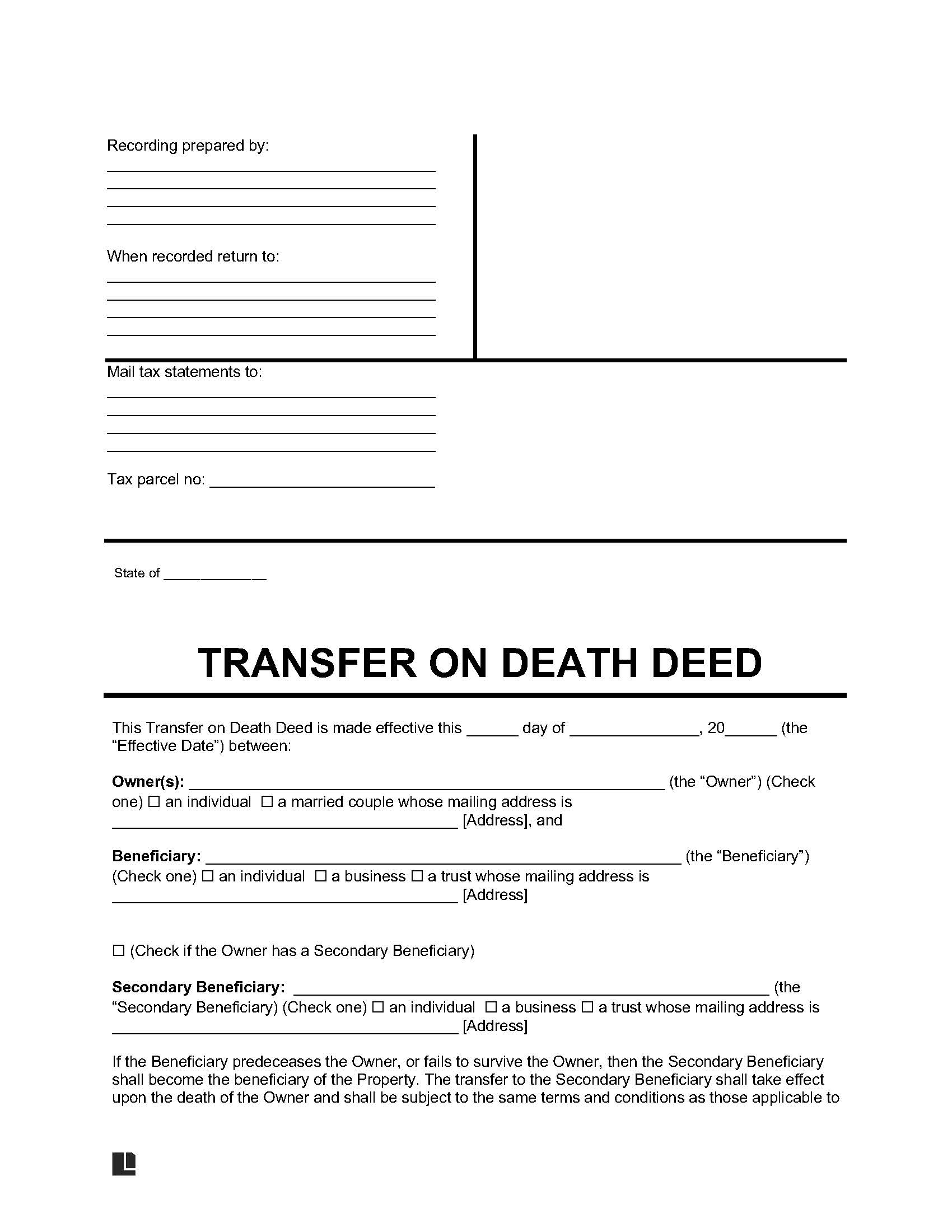
Sample Transfer on Death Deed
View an example of a transfer on death deed to see how to structure your document for a probate-free property transfer. Complete it using Legal Templates’s guided form, then download a printable version in PDF or Word format.
Can a Transfer on Death Deed Be Contested?
Yes, a transfer on death deed can be contested in any state that allows them. Even though it skips probate, it’s not immune to legal challenges.
One of the common problems with transfer on death deeds is that heirs, creditors, or other interested parties can still bring the issue to probate court. They might claim fraud, undue influence, lack of mental capacity, or improper signing.
Revoking a Transfer on Death Deed
A property owner can revoke a transfer on death deed for any reason while they’re alive. They do not need the beneficiaries’ consent. They can fill out a revocation form and file it with the same land records office where they filed the original TOD deed.
Other ways a property owner can revoke a current TOD deed include the following:
- Record a new TOD deed. When the property owner records a new TOD deed for a piece of property, it invalidates the old one.
- Sell the property. Selling the property revokes a previous TOD deed.
- Transfer the property. If the property owner transfers the property under a TOD deed into a trust, the property’s ownership changes, revoking the previous TOD deed.
Alternatives to a Transfer on Death Deed
Transfer on death deeds can come with problems, including a lack of availability in certain states and an impact on beneficiaries’ eligibility for income- and asset-based programs like Medicaid.
You may consider alternatives to a transfer on death deed, such as a Lady Bird deed. A Lady Bird deed is available in states (Florida, Michigan, Texas, Vermont, West Virginia) where a TOD deed is not allowed. It also offers some benefits over a TOD deed, including flexibility with Medicaid planning.
If you don’t live in a state that allows Lady Bird deeds, other TOD deed alternatives are available. The one you pick will depend on your estate planning needs and preferences. Consider the alternatives listed below:
- Revocable living trust: A revocable living trust transfers property according to the trust’s terms and can manage assets during life and after death.
- Last will: A last will must go through probate, but it can be a good solution if you have more assets to distribute beyond just a primary residence.
- Joint tenancy with right of survivorship: This option allows property to pass automatically to the surviving owner but gives co-owners immediate ownership rights during life.
- Tenancy by the entirety (married couples only): This option provides automatic transfer to the surviving spouse with added creditor protection.
- Life estate deed: A life estate deed lets the owner retain use of the property during life while designating who inherits it at death.
- Quitclaim deed: During your lifetime, you can transfer property without guaranteeing the title’s condition.
- Warranty deed: During your lifetime, you can transfer property while offering warranties on the title’s condition.
- Gifting: During your lifetime, you can gift property to a family member or another individual. You may be able to avoid gift taxes if the value of the gifted property falls below the lifetime exemption.