


Key Takeaways
Based on pricing data from 909 law firms across all 50 states and Washington, DC:
Typical estate planning document costs:
- Power of attorney: $300 (median)
- Last will and testament: $625 (median)
- Revocable living trust: $2,475 (median)
Major findings from the data:
- Flat-fee pricing dominates the industry
- Only about 6% of firms reported hourly billing for these documents.
- Price transparency remains limited
- Only 37% of firms provided pricing upfront.
- 19% pushed consultations before giving any estimate.
- Many required text and email marketing opt-ins just to submit an inquiry.
- Firm choice matters more than location
- Prices vary far more between law firms than between states.
- Estate planning packages can reduce costs
- Will packages save about $225 compared with buying documents separately.
- Trust packages save roughly $1,000.
- Couples’ plans can lower costs even further
- Couples’ packages save about $250 per person for wills and $1,200 per person for trust plans.
They say the only two things guaranteed in life are death and taxes. For many Americans, there’s a third: lawyer fees.
Estate planning determines what happens to your money and property if you become incapacitated or pass away. It typically involves documents such as a power of attorney (POA), a last will and testament, and a revocable living trust. These documents record your wishes and help your loved ones manage your affairs when it matters most.
For many Americans, estate planning costs can feel unpredictable. Many law firms do not publish their prices, and some require a consultation before they will share an estimate of what your documents will cost.
To better understand what people actually pay, we gathered pricing data from hundreds of law firms across all 50 states and Washington, DC. Our research combines publicly available pricing from law firm websites with direct outreach to thousands of firms. This allowed us to estimate the typical cost of preparing common estate planning documents.
Our research suggests that price transparency is limited across estate planning firms. Of the 2,469 law firms we contacted, only 909 firms (37%) provided pricing information without requiring a consultation.
Our results also revealed a surprising pattern: while costs are relatively consistent across states, pricing can vary dramatically between law firms within the same state. In other words, where you shop may matter more than where you live.
We also compared attorney pricing with DIY legal document services to better understand the range of options available to Americans.
Below, we break down the cost of estate planning documents in the US, including national medians, state-by-state pricing, and key insights from our analysis.
Estate Planning Packages vs Single Documents
When estate planning, you can either create standalone documents or choose a packaged plan that includes multiple documents. These plans typically address asset distribution, medical decisions, and financial matters.
The exact documents included vary by attorney and the complexity of the package. Basic options focus on essential documents. More comprehensive plans may also include end-of-life plans, deeds, and real property transfer documents. Many estate planning packages include some of the following:
| Document | What It Does |
|---|---|
| Last will and testament | Explains who receives your property after you pass away and names the person who will handle your estate. |
| Financial power of attorney | Allows someone you trust to manage your money and financial matters if you’re unable to manage them yourself. |
| Healthcare/medical power of attorney, living will, or advance directive | Records your medical care wishes and names the person who will make health care decisions if you are incapacitated and can’t make decisions for yourself. |
| HIPAA release or authorization | Gives trusted individuals permission to speak with doctors and access your medical information. |
| Guardian nomination for minors | Names who should care for minor children if both parents pass away. |
| Revocable living trust | Holds your assets during your lifetime and transfers them to beneficiaries after death, often avoiding probate. |
| Pour-over will | Ensures any remaining assets are transferred to your trust after death. |
| Disposition of remains | Records your wishes for burial, cremation, or funeral arrangements. |
| Assignment of personal property | Lists personal items, such as jewelry or family heirlooms, and who should receive them after you pass away. |
Most estate plans are structured around one primary document: either a last will and testament or a revocable living trust.
When an estate plan is based on a last will, the supporting documents mainly help others manage decisions if you become unable to do so yourself. These plans focus on distributing property after death while also preparing for medical or financial emergencies.
A typical last will estate planning package includes:
- Last will and testament
- Living will, advance directive, or medical power of attorney
- Financial power of attorney
- HIPAA authorization
- Disposition of remains (occasionally)
- Guardian nomination (if applicable)
Trust-based estate plans are generally more comprehensive because assets need to be transferred into the trust during your lifetime. Once transferred, the trust manages those assets during incapacity and distributes them after death.
A typical revocable living trust estate planning package includes:
- Revocable living trust
- Pour-over will
- Financial POA
- Deed or property transfer for one property into the trust
- Living will, advance directive, or healthcare POA
- HIPAA authorization
- Guardian nomination (if applicable)
- Certificate of trust (occasionally)
Which Estate Planning Documents Do You Actually Need?
Estate planning packages often include multiple documents. But, more paperwork does not always mean better planning.
Most people can benefit from having a financial or a medical power of attorney for emergencies and medical care decisions. However, it is rarely necessary to have both a revocable living trust and a last will and testament.
Both documents serve a similar purpose: they direct how your assets should be distributed after death. The best choice depends on how complex your estate is and what you want your plan to accomplish.
A revocable living trust offers more flexibility and helps avoid probate. Generally, people with more complex assets or multiple properties use a living trust for easier transfers to beneficiaries. A living trust also allows you to keep your assets and distribution private, unlike a last will, which may create public records of your terms.
A last will covers simple or smaller estates that are likely to have straightforward probate. If you have a clear plan for distributing your assets, a last will can provide concise, binding terms. A last will also allows you to appoint a legal guardian for any minor children, which is not possible under a living trust.
About This Study
This report analyzes pricing for estate planning documents across the United States. We collected pricing data using two methods:
- Public pricing research from 266 law firm websites
- Direct outreach to 2,469 law firms across all 50 states and Washington, DC
In total, 909 firms provided pricing estimates used in this analysis.
Some states are marked as N/A due to limited pricing data from law firms in those areas. Reliable estimates could not be calculated for those states.
Detailed methodology is available in the Methods section below.
National Cost of Estate Planning Documents in the US
Estate planning documents can come with a high price tag. Lawyer fees also vary depending on location, experience, and the number of hours spent planning. To understand what Americans typically pay, we collected pricing data from hundreds of estate planning attorneys across the United States.
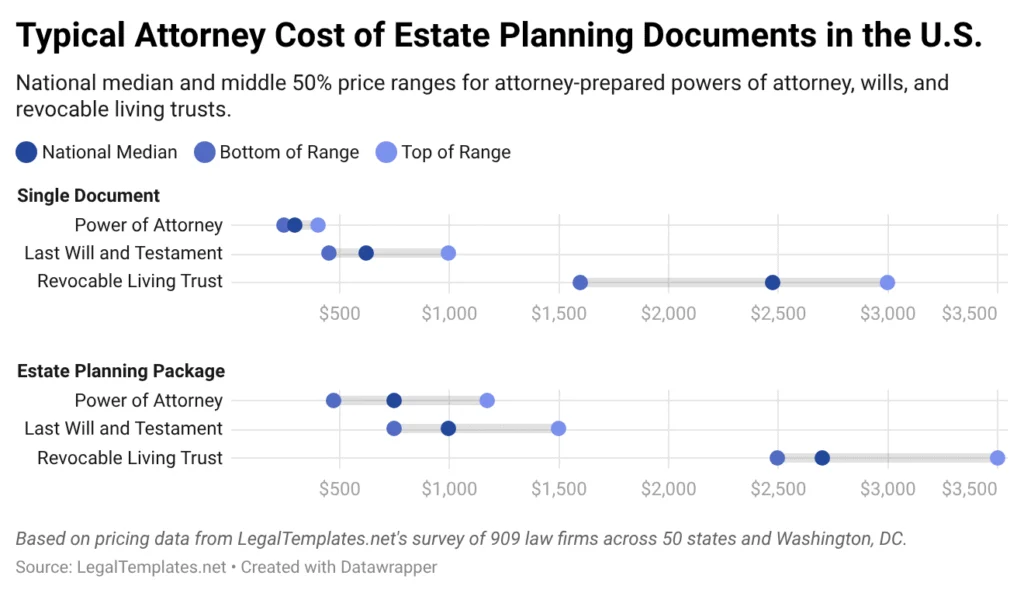
The table below shows the national median cost of common estate planning documents, along with the middle 50% price range for law firms in our dataset. We use medians instead of averages because pricing data is skewed by high-cost quotes.
| Document | Plan Type | National Median | Middle 50% Range | Number of Firms |
|---|---|---|---|---|
| Power of attorney | Single document | $300 | $250–$400 | 371 |
| Power of attorney | Package | $750 | $475–$1,175 | 54 |
| Last will and testament | Single document | $625 | $450–$1000 | 307 |
| Last will and testament | Package | $1,000 | $750–$1,500 | 319 |
| Revocable living trust | Single document | $2,475 | $1,600–$3,000 | 226 |
| Revocable living trust | Package | $2,700 | $2,500–$3,500 | 221 |
What is the middle 50% range?
The middle 50% range, also called the interquartile range (IQR), represents the prices between the 25th and 75th percentiles of our dataset. Using the median and this range helps remove extreme outliers and provides a more accurate picture of what most Americans actually pay for estate planning documents.
Power of Attorney Cost by State
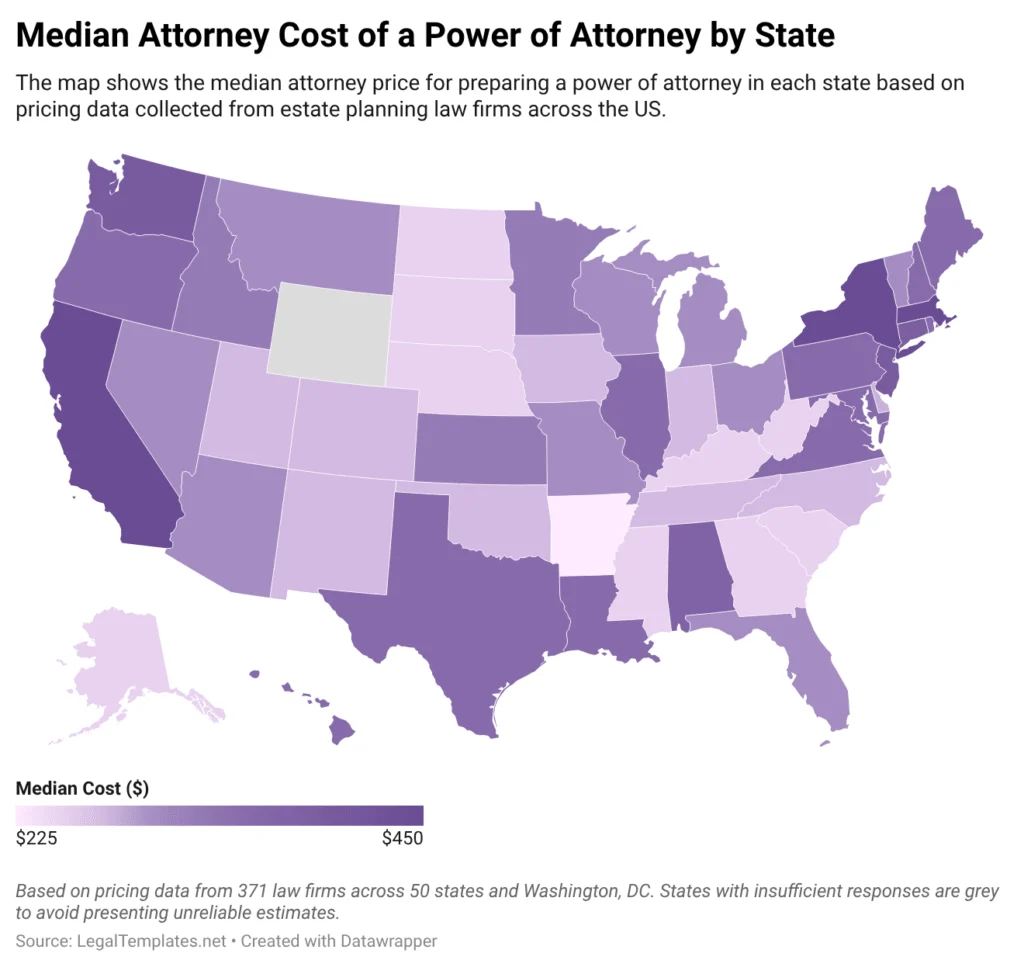
While the national figures provide a broad overview of pricing, costs can vary by state and by the law firm preparing the documents.
The table below highlights state-level median costs for a power of attorney. Within this table, you’ll also find the middle 50% price range, which shows how pricing varies among firms within the same state.
These two figures illustrate what consumers typically pay while filtering out unusually high or low quotes.
States with fewer responses are included, but may have a wider price range due to limited available data.
State-level medians and ranges are based on single document pricing data from 371 law firms.
| State | Median | Middle 50% Range |
|---|---|---|
| Alabama | $375 | $290–$390 |
| Alaska | $250 | $250–$350 |
| Arizona | $300 | $250–$500 |
| Arkansas | $225 | $150–$325 |
| California | $450 | $360–$500 |
| Colorado | $275 | $200–$500 |
| Connecticut | $390 | $335–$445 |
| Delaware | $280 | $255–$410 |
| Florida | $300 | $250–$500 |
| Georgia | $250 | $250–$300 |
| Hawaii | $350 | $300–$400 |
| Idaho | $325 | $250–$375 |
| Illinois | $350 | $250–$450 |
| Indiana | $275 | $225–$350 |
| Iowa | $275 | $250–$350 |
| Kansas | $325 | $250–$400 |
| Kentucky | $250 | $225–$350 |
| Louisiana | $350 | $300–$450 |
| Maine | $350 | $300–$450 |
| Maryland | $350 | $300–$450 |
| Massachusetts | $450 | $350–$600 |
| Michigan | $300 | $250–$400 |
| Minnesota | $325 | $275–$450 |
| Mississippi | $250 | $200–$350 |
| Missouri | $300 | $250–$350 |
| Montana | $300 | $250–$400 |
| Nebraska | $250 | $225–$350 |
| Nevada | $300 | $250–$450 |
| New Hampshire | $350 | $300–$500 |
| New Jersey | $400 | $350–$600 |
| New Mexico | $275 | $225–$350 |
| New York | $450 | $350–$600 |
| North Carolina | $275 | $250–$350 |
| North Dakota | $250 | $250–$300 |
| Ohio | $300 | $250–$400 |
| Oklahoma | $275 | $225–$350 |
| Oregon | $350 | $300–$450 |
| Pennsylvania | $350 | $300–$450 |
| Rhode Island | $350 | $300–$400 |
| South Carolina | $250 | $225–$350 |
| South Dakota | $250 | $250–$300 |
| Tennessee | $275 | $225–$350 |
| Texas | $350 | $275–$450 |
| Utah | $275 | $225–$350 |
| Vermont | $300 | $250–$350 |
| Virginia | $350 | $300–$450 |
| Washington | $400 | $350–$500 |
| West Virginia | $250 | $225–$300 |
| Wisconsin | $300 | $250–$350 |
| Wyoming | N/A | N/A |
| Washington DC | $450 | $400–$600 |
Last Will and Testament Cost by State
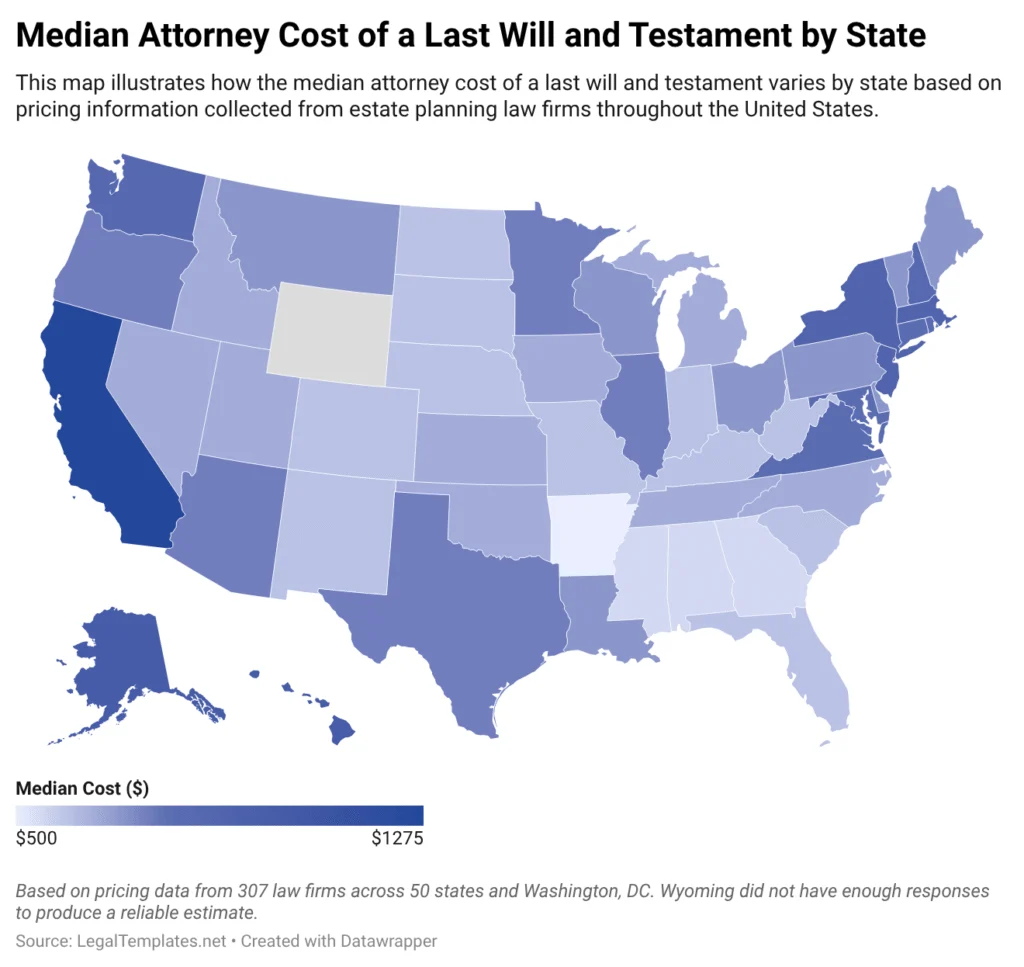
Similar to a power of attorney, the cost of a last will and testament can differ significantly depending on the state and the law firm you choose.
The following table presents state-level median costs for creating a will, along with the middle 50% price range to highlight price variation among firms within each state. Together, these figures give a realistic picture of what you might pay, excluding outlier quotes that could skew the data.
Some states have fewer responses, so their ranges may appear wider due to the smaller sample size.
State-level medians and ranges are based on single document pricing data from 307 law firms.
| State | Median | Middle 50% Range |
|---|---|---|
| Alabama | $550 | $500–$1200 |
| Alaska | $1,000 | $465–$1875 |
| Arizona | $750 | $625–$1350 |
| Arkansas | $500 | $400–$650 |
| California | $1,275 | $690–$2950 |
| Colorado | $600 | $500–$850 |
| Connecticut | $800 | $650–$1000 |
| Delaware | $700 | $600–$900 |
| Florida | $600 | $500–$900 |
| Georgia | $550 | $450–$850 |
| Hawaii | $1,000 | $850–$1500 |
| Idaho | $650 | $550–$750 |
| Illinois | $750 | $600–$1000 |
| Indiana | $600 | $500–$800 |
| Iowa | $650 | $600–$750 |
| Kansas | $650 | $550–$850 |
| Kentucky | $600 | $500–$850 |
| Louisiana | $700 | $600–$900 |
| Maine | $700 | $600–$900 |
| Maryland | $800 | $650–$1100 |
| Massachusetts | $900 | $750–$1400 |
| Michigan | $650 | $550–$900 |
| Minnesota | $750 | $600–$1000 |
| Mississippi | $550 | $450–$750 |
| Missouri | $600 | $500–$850 |
| Montana | $700 | $600–$900 |
| Nebraska | $600 | $500–$800 |
| Nevada | $650 | $550–$900 |
| New Hampshire | $850 | $700–$1200 |
| New Jersey | $900 | $750–$1400 |
| New Mexico | $600 | $500–$850 |
| New York | $900 | $700–$1500 |
| North Carolina | $650 | $550–$900 |
| North Dakota | $600 | $550–$700 |
| Ohio | $700 | $600–$900 |
| Oklahoma | $650 | $550–$850 |
| Oregon | $750 | $650–$1000 |
| Pennsylvania | $700 | $600–$1000 |
| Rhode Island | $800 | $700–$900 |
| South Carolina | $600 | $500–$850 |
| South Dakota | $600 | $550–$700 |
| Tennessee | $650 | $550–$900 |
| Texas | $750 | $600–$1000 |
| Utah | $650 | $550–$850 |
| Vermont | $700 | $600–$900 |
| Virginia | $800 | $650–$1100 |
| Washington | $850 | $700–$1100 |
| West Virginia | $600 | $500–$750 |
| Wisconsin | $700 | $600–$900 |
| Wyoming | N/A | N/A |
| Washington DC | $900 | $750–$1200 |
Revocable Living Trust Planning Cost by State
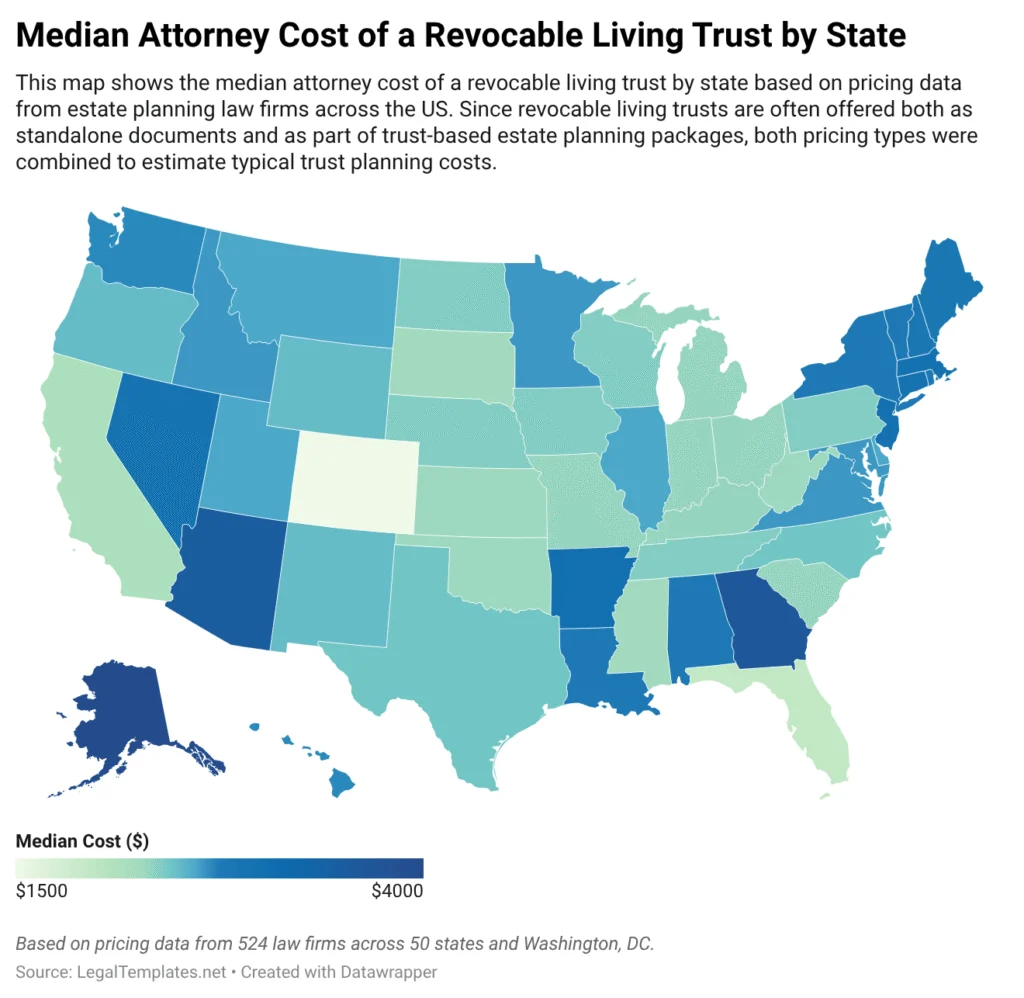
Revocable living trusts are sometimes prepared as standalone documents and sometimes as the primary document in a trust-based estate plan.
In our dataset, the national median price for a standalone revocable living trust was $2,475, compared with $2,700 for trust-based estate planning packages — a difference of roughly 9%.
Because the trust itself is the central legal document in both cases, and the observed pricing difference was relatively small, we combined the two groups to estimate typical trust planning costs by state.
The table below includes pricing data from 524 law firms nationwide, covering both standalone revocable living trusts and trust-based estate planning packages.
To give a realistic view of costs, we’ve provided the state-level median costs and the middle 50% price range for revocable living trusts in each state. This approach highlights variations among law firms while minimizing the impact of unusually high or low prices. For states with fewer responses, the spread may be broader due to limited data.
| State | Median | Middle 50% Range |
|---|---|---|
| Alabama | $2,750 | $2,250–$3,150 |
| Alaska | $4,000 | $3,250–$4,650 |
| Arizona | $3,500 | $2,500–$3,625 |
| Arkansas | $3,000 | $2,500–$3,250 |
| California | $2,150 | $1,850–$2,650 |
| Colorado | $1,500 | $1,100–$3,125 |
| Connecticut | $2,925 | $2,600–$3,375 |
| Delaware | $2,600 | $2,000–$3,175 |
| Florida | $1,950 | $1,250–$3,125 |
| Georgia | $3,650 | $3,125–$4,800 |
| Hawaii | $2,700 | $2,250–$3,125 |
| Idaho | $2,650 | $2,100–$3,050 |
| Illinois | $2,600 | $2,100–$3,000 |
| Indiana | $2,350 | $1,900–$2,850 |
| Iowa | $2,400 | $2,050–$2,900 |
| Kansas | $2,300 | $1,850–$2,750 |
| Kentucky | $2,350 | $1,900–$2,850 |
| Louisiana | $2,750 | $2,300–$3,200 |
| Maine | $2,800 | $2,400–$3,200 |
| Maryland | $2,650 | $2,200–$3,100 |
| Massachusetts | $2,950 | $2,450–$3,500 |
| Michigan | $2,350 | $1,950–$2,800 |
| Minnesota | $2,650 | $2,200–$3,100 |
| Mississippi | $2,250 | $1,850–$2,600 |
| Missouri | $2,350 | $1,900–$2,800 |
| Montana | $2,600 | $2,200–$3,000 |
| Nebraska | $2,400 | $2,050–$2,900 |
| Nevada | $2,900 | $2,450–$3,350 |
| New Hampshire | $2,800 | $2,350–$3,200 |
| New Jersey | $2,950 | $2,400–$3,500 |
| New Mexico | $2,500 | $2,100–$2,900 |
| New York | $2,750 | $2,300–$3,300 |
| North Carolina | $2,450 | $2,050–$2,900 |
| North Dakota | $2,400 | $2,050–$2,850 |
| Ohio | $2,350 | $1,950–$2,800 |
| Oklahoma | $2,300 | $1,900–$2,700 |
| Oregon | $2,500 | $2,050–$2,950 |
| Pennsylvania | $2,400 | $1,900–$2,900 |
| Rhode Island | $2,750 | $2,300–$3,200 |
| South Carolina | $2,350 | $1,950–$2,800 |
| South Dakota | $2,250 | $1,900–$2,650 |
| Tennessee | $2,400 | $1,950–$2,850 |
| Texas | $2,450 | $2,050–$2,900 |
| Utah | $2,600 | $2,200–$3,050 |
| Vermont | $2,750 | $2,350–$3,200 |
| Virginia | $2,650 | $2,200–$3,100 |
| Washington | $2,700 | $2,250–$3,200 |
| West Virginia | $2,300 | $1,950–$2,700 |
| Wisconsin | $2,400 | $2,000–$2,850 |
| Wyoming | $2,500 | $2,100–$2,900 |
| Washington DC | $3,100 | $2,600–$3,600 |
Detailed Findings From Our Estate Planning Cost Study
Beyond the pricing tables, our outreach also revealed several patterns in how law firms price and offer estate planning services. The findings below highlight key trends from our research, including pricing transparency, billing models, and cost differences across firms.
1. Estate Planning Prices Are Often Difficult to Compare
Our outreach revealed that obtaining upfront pricing from estate planning attorneys can be surprisingly difficult. In fact, most law firms we contacted would not provide pricing without requiring additional steps such as consultations, client questionnaires, or follow-up discussions.
Of the 2,469 law firms we contacted, only 909 firms (37%) provided pricing information.
In addition, despite our outreach emails clearly stating that the person was not interested in scheduling a consultation until a price estimate was provided, 19% of firms (479 firms) still pushed a consultation before sharing any pricing details.
Only 266 law firms publicly listed flat-fee pricing on their websites. In contrast, 457 firms, about 1.7 times as many, advertised “transparent” or flat-fee pricing but did not publish any actual prices online.
In addition, many law firms use contact forms that require individuals to opt in to text messaging, email marketing lists, or newsletters before submitting an inquiry.
A small number of responses were very direct. Some firms indicated they were not interested in working with clients who primarily compared prices. Others suggested that individuals seeking a single document might be better served by an online legal document service.
These responses reflect different approaches to pricing and client relationships. However, they also highlight a larger issue: estate planning prices are still difficult to compare upfront.
As a result, consumers may need to contact multiple firms before they can determine typical pricing in their area. This makes shopping more time-consuming and frustrating than for many other professional services.
2. Expect To Be Charged a Flat-Fee, Not Hourly
Although hourly billing is often associated with legal services, our survey suggests that flat-fee pricing is the dominant model for estate planning documents.
Among the 909 law firms that provided pricing estimates through our outreach, only 56 firms indicated that they charge hourly for these documents. The remaining firms provided flat-fee estimates.
Overall, only about 6% of firms in our dataset use hourly billing for these estate planning documents, meaning that roughly 94% of firms rely on flat-fee pricing.
Flat fees are common in estate planning because the work involved in preparing standard documents is predictable, especially in relatively simple estates. Attorneys can typically estimate the time required to draft a power of attorney, will, or trust, which should make it easier to quote a fixed price upfront.
3. Estate Planning Prices Vary More by Law Firm Than by State
It’s a common assumption that estate planning is more expensive in large or high-cost states, such as California, Texas, and New York. However, our data does not support this assumption.
For all document types, pricing differences between law firms within the same state often exceed differences between states. This suggests consumers may benefit more from comparing firms than from assuming costs depend mainly on location.
Across states, median prices fall within relatively narrow bands:
| Document | Typical Price Variation Between States | Example Price Variation Between Law Firms (Within One State) |
|---|---|---|
| Power of attorney | $250–$500 | $250–$950 (Massachusetts) |
| Last will and testament | $500–$900 | $500–$1,200 (California) |
| Revocable living trust | $2,000–$3,500 | $1,100–$3,125 (Colorado) |
In most cases, state medians fall within 30–40% of the national median, suggesting that geography influences pricing but does not dramatically change the cost of estate planning.
On the other hand, the middle 50% range is significantly wider in many states. In several states, the cost of a single document at a higher-priced firm is three to four times higher than at a lower-priced firm, even after excluding extreme outliers.
Example One: Massachusetts Power of Attorney
- Middle 50% Range: $250–$950
A person selecting a higher-priced firm could pay nearly four times as much as one selecting a lower-priced firm within the same state. This spread is far larger than typical differences in median prices across states.
Example Two: California Last Will and Testament
- Middle 50% Range: $500–$1,200
This means that within California alone, a client at the 75th percentile firm ($1,200) could pay twice as much as a client at the 25th percentile firm ($500). This variation occurs even though both firms fall within the middle 50% of pricing in the state.
Example Three: Colorado Revocable Living Trust
- Middle 50% Range: $1,100–$3,125
In Colorado, a person choosing a higher-priced firm could pay nearly three times as much as someone selecting a lower-priced firm, even though both firms fall within the middle 50% of pricing. This variation highlights how trust pricing can differ substantially between law firms within the same state.
What This Means for You
These examples suggest that where you shop matters more than where you live. Even within one state, law firm pricing can vary significantly.
Since the COVID-19 pandemic, many estate planning attorneys have adopted video consultations and remote document preparation. This allows clients to work with firms across their state instead of choosing only nearby offices.
As long as an attorney is licensed to practice in your state, you may have more options than simply choosing between the closest firms.
4. Estate Planning Packages Often Provide Better Value
As we mentioned earlier, many law firms offer estate planning services as bundled packages that include multiple documents.
A last will and testament estate planning package typically includes at least three documents (last will, financial POA, and healthcare POA). With a median package cost of $1,000, the price per document is roughly $333.
If someone bought separately at medians:
- Will: $625
- POA: $300
- Healthcare POA: $300
The total separate cost would be about $1,225. Thus, a last will and testament package can save a person around $225 in legal fees.
Revocable living trust packages tend to save even more. A trust package usually contains at least four documents (revocable living trust, pour-over will, financial POA, healthcare POA) and costs about $2,700. This puts the price per document in the package at $675.
If someone were to buy these four documents separately at the national medians, the total cost would be around $3,700. Therefore, a trust estate planning package can save a person around $1,000 compared to preparing each document individually.
5. Couples’ Packages Will Save You Even More Money
Some firms also offer estate planning packages for couples that can include separate or joint documents. Will-based plans usually involve two separate wills, while trust-based plans involve a single joint revocable living trust.
A couple’s last will and testament estate package typically includes:
- Two last wills and testaments
- Two financial POAs
- Two living wills, advance directives, or healthcare POAs
- Two HIPAA releases
- One guardian nomination (if applicable)
Whereas, a couple’s revocable living trust estate package typically includes:
- One joint revocable living trust
- Two pour-over wills
- Two financial POAs
- Two living wills, advance directives, or healthcare POAs
- Two HIPAA releases
- One deed to transfer property into the trust
Many firms offer discounts when adding a partner to an estate planning package or choosing one designed specifically for couples. The national costs of couple’s estate planning packages are as follows.
| Document | National Median Cost per Couple | Middle 50% Range | Number of Firms |
|---|---|---|---|
| Couple’s last will and testament package | $1,500 | $1,075–$2,225 | 167 |
| Couple’s revocable living trust package | $3,000 | $2,200–$4,000 | 154 |
If each partner pays half of the total cost:
- Will package: $750 per person
- Trust package: $1,500 per person
Compared to the national median cost of individual packages, this results in savings of:
- $250 per person for will packages
- $1,200 per person for trust packages
Trust packages offer particularly large savings because couples typically create one joint revocable living trust rather than two separate trusts.
However, it’s important to note that a joint revocable living trust holds joint assets with both partners as grantors and trustees. If a couple has children from prior marriages, separate property concerns, or different inheritance plans, a joint trust potentially won’t work well for their needs.
Attorney Planning Cost vs DIY Legal Document Platforms
Hiring an attorney to prepare estate planning documents can be significantly more expensive than using a DIY legal document platform. As a result, many Americans have turned to online DIY legal platforms for their legal needs.
DIY legal document platforms typically charge either a subscription fee or a one-time payment that allows users to generate multiple legal forms. Below are the current plan prices for several popular platforms:
| Site | Plan Cost |
|---|---|
| Legaltemplates.net | $119.88 per year ($9.99 per month) |
| eForms.com | $144 ($12 per month) |
| Lawdepot.com | $155.88 per year ($12.99 per month) |
| Rocketlawyer.com | $199 per year ($16.58 per month) |
| Legalzoom.com | $149 for a Pro Will package $399 for a Basic Trust package (30-day access only) |
Even if someone only creates one document during their plan period, DIY services are often significantly cheaper than hiring an attorney. For comparison, we used the cost of a one-year subscription (or the listed one-time package price where applicable):
| Document | Attorney Median | DIY Platform Cost | Typical Savings |
|---|---|---|---|
| Power of attorney | $300 | $120–$156 | ~50–60% |
| Last will and testament | $625 | $120–$156 | ~75–80% |
| Revocable living trust | $2,475 | $120–$399 | ~85–95% |
In many cases, the cost of a full year of access to a DIY legal document platform is less than the cost of a single attorney-prepared power of attorney.
For users who generate multiple documents during a subscription period, the effective cost per document can be even lower.
Why Attorney Estate Planning Costs More and Varies Widely
Attorney-prepared estate planning documents usually cost more because the price includes lawyer and paralegal services in addition to document drafting. Compared to DIY platforms, law firms often charge more due to factors such as:
- Legal consultations and advice. Attorneys may review your finances, discuss planning strategies, and customize documents for your situation. You could be charged hourly for this work, which can lead to hundreds or thousands of dollars in fees.
- Professional expertise. Lawyers factor their experience, specialization, and reputation into the cost of preparing estate planning documents.
- Package-based pricing. Many estate planning attorneys structure services as bundled plans that include multiple documents, which can increase total costs if you only need one or two forms.
- Administrative and operational costs. Law firms must cover staff salaries, office space, insurance, and other operating costs.
- Future revisions or updates. Updating estate planning documents later may require additional consultations and drafting fees that are rarely included in the original price.
DIY legal document platforms operate differently. Instead of charging for individual legal services, they typically provide guided document builders and attorney-reviewed templates for a predictable subscription or one-time fee. This allows users to create and update multiple documents at a significantly lower cost.
Choosing the Right Option: DIY Site or Attorney
Overall, DIY legal document platforms, like Legal Templates, can help you get the estate planning documents you need for a fraction of the cost of lawyers’ fees. Attorney-approved templates help guide you through the drafting process, so you don’t miss any key information. If you have a straightforward estate planning situation, it’s much more affordable to write them yourself.
However, individuals with complex estates, specialized tax concerns, or blended family situations may still benefit from consulting an estate planning attorney. If you do hire a lawyer, make sure to do your research, as prices among law firms in the same state can vary widely.
If your estate planning needs remain simple, DIY sites offer substantial cost savings. You’ll know the full cost upfront, with no hidden fees or surprise charges from a lawyer later.
For many households, the choice ultimately comes down to cost, complexity, and how much legal guidance is needed.
Methods
This analysis was conducted using a two-stage data collection process covering all 50 states and the District of Columbia.
Public Pricing Research
First, we collected pricing data from law firms that publish their estate planning fees directly on their websites. This resulted in cost estimates from 266 law firms across the country.
During this phase, we also identified 457 firms that advertised “transparent, flat-fee pricing” but did not actually publish any pricing information on their sites.
Law Firm Outreach
Next, we conducted outreach to estate planning attorneys to collect additional pricing information. Where possible, we contacted approximately 40 firms per state via email or website contact forms.
We identified firms through Google search results, including organic listings, ads, and map results. This approach reflects how an average consumer might search for an estate planning attorney.
We completed outreach to 2,469 law firms across the United States during this phase of data collection.
To standardize requests and ensure consistent responses, outreach emails were written using consumer personas based on the typical users of estate planning documents on Legal Templates. Persona names were chosen using gender-neutral first names and common US last names from the 2010 census to reflect realistic consumer inquiries.
Each persona requested pricing for a power of attorney, a last will, or a revocable living trust, using a simple estate planning scenario (see the Appendix for the full outreach email copy). This approach helped ensure that firms were responding to comparable requests. This allowed us to compare pricing more consistently across states.
Outreach message for power of attorney
Hello,

I’m looking to have a power of attorney prepared and wanted to ask about typical cost and process.

To give you a sense of what I’m looking for:

-One agent only
-Broad authority (financial and related matters)
-Durable — authority should continue if I become incapacitated
-Effective immediately
-No co-agents, conditions, or special triggers

This would be for general planning purposes, not a one-time or limited transaction.

Could you share whether this is usually handled as a flat fee or hourly, and a rough price and/or hours of work for something like this?

I’m not interested in a consultation without knowing a price point first.

Thank you,

Jordan Williams
Outreach message for last will and testament
I’m looking to get a basic last will and testament prepared and was hoping you could give me a general idea of pricing.

My situation is fairly straightforward:

-Adult, single individual (no longer married)
-Simple assets (bank accounts, personal property, no business interests)
-I’d be leaving most of my estate to family (ex-spouse and children)
-No minor children
-I’d also like to include a simple pet guardian clause
-No trusts or tax planning needed
-No charitable donations required in the will

Could you let me know:

-Whether you typically charge a flat fee or hourly rate for this type of will
-The usual price you would expect for something like this (or the number of hours of work, if charging hourly)
-What’s generally included (revisions, execution guidance, etc.)

I’m just trying to understand what’s typical before moving forward.

Thank you for your time,

Taylor Johnson
Outreach message for revocable living trust
Hi there. I’m getting a few estimates for setting up a basic revocable living trust and wanted to see what you typically charge.

This would be a straightforward trust:
-Standard assets (no business or tax planning)
-I’d act as initial trustee
-Naming successor trustees
-Children as beneficiaries (no spouse)
-Including one home

Do you generally handle this as a flat fee or hourly? What would be the flat fee, or if hourly, how many hours of work do you estimate?

I’m getting estimates from multiple firms before proceeding with any consultations or retainers.

Thanks in advance,

Cameron Jones