What Is a West Virginia Quitclaim Deed?
A West Virginia quitclaim deed is a legal document that transfers a person’s ownership interest in real estate to another party. This form does not guarantee that the grantor owns the property in full or that the title is clear. In West Virginia, a quitclaim deed form is recognized under WV Code § 36-3-5.
West Virginia Quitclaim Deed Requirements
West Virginia law sets particular rules for quitclaim deeds to be valid. A clear, complete deed helps you avoid delays and move forward with your property transfer.
Party Information and Property Details
Your quitclaim deed form should be in writing (WV Code § 36-1-3). West Virginia recognizes traditional quitclaim language under WV Code § 36-3-7, although you do not need to copy that language exactly. Still, it is important to use similar language to avoid creating warranties.
Your form should also clearly identify the parties involved and the property being transferred. Here are the key details you should include on your form:
- The full legal names and addresses of both the grantor and grantee
- The full legal description of the property
- The date of transfer
- The property’s county and address
Note that the legal description is not the mailing address of your property. It is the description listed on the most recently recorded deed and may include details like:
- Metes and bounds
- Lot and block
- References to the Public Land Survey System (PLSS)
Preparer Name
West Virginia requires the quitclaim deed form to include the name of the person who prepared the document (WV Code § 39-1-2a). Typically, the preparer’s name is listed at the end of the deed. Failure to include the name does not make the deed invalid, but the clerk may refuse to record a document if it does not comply.
Formatting Requirements
There are certain formatting requirements your quitclaim deed form must meet in order to be recorded in West Virginia. Under WV Code § 39-1-11, your deed must:
- Be printed on only one side of the page
- Use a font size of at least 10 points
- Have at least two font points of space between each line
County clerks may also require clear margins and legible text. It is best to check with the clerk’s office in the county where your property is located before filing your deed.
Signing and Notarization
A quitclaim deed must be signed by the grantor. Under WV Code § 39-1-2, the clerk will only accept the deed if the signature is:
- Acknowledged before a notary public or authorized official
- Proved by two witnesses
If your quitclaim deed does not involve payment or lists a property value of $100 or less and no excise tax is paid, the grantee must also sign and acknowledge the deed before it can be recorded. A deed recorded without the grantee’s signature in these situations may be void (WV Code § 39-1-2(b)(2)).
Required WV Tax And Value Forms
You may have to file additional tax documents along with your deed in West Virginia. Under WV Code § 11-22-6, you must include a Declaration of Consideration or Value along with your deed, unless the transfer is exempt from the real estate excise tax. The grantor is also generally required to submit a Sales Listing Form (Form STC 12:39) when recording the quitclaim deed form. This form reports the property’s sale details to the state.
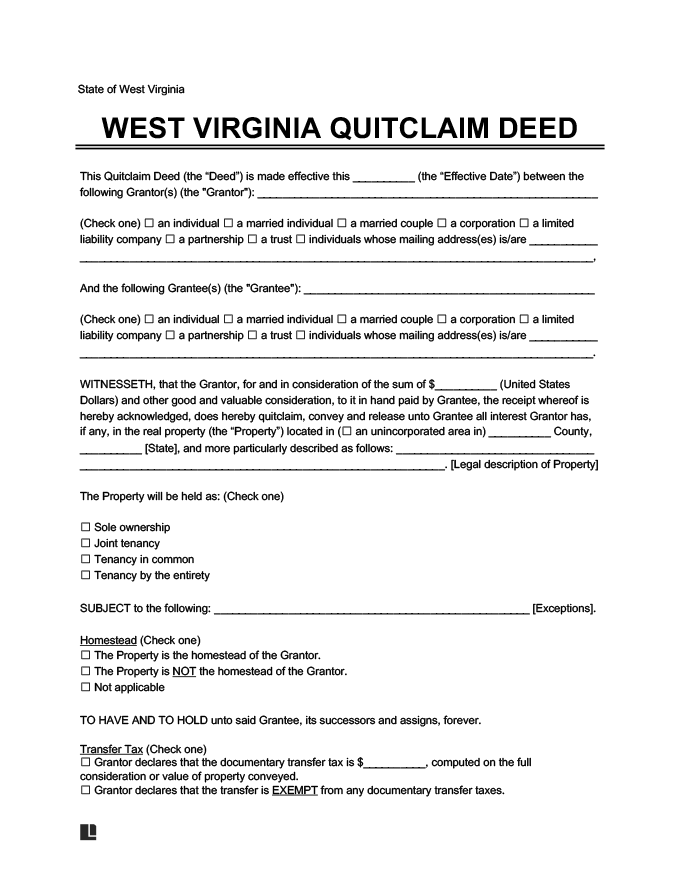
Sample West Virginia Quitclaim Deed
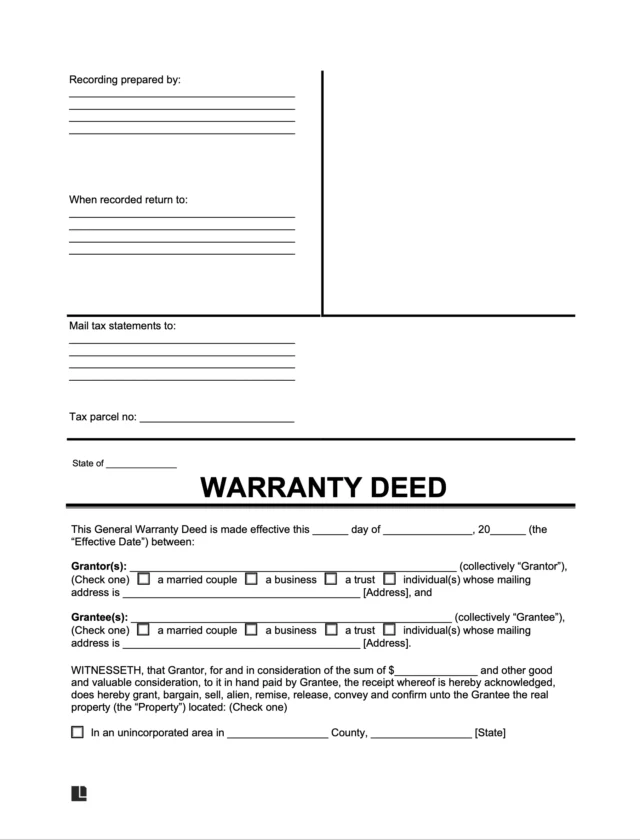
Review a sample West Virginia quitclaim deed form below to see all the details you’d need to include. Once you’re ready, use Legal Templates’s step-by-step questionnaire to complete it, then download it as a PDF or Word file.
How to File a Quitclaim Deed in West Virginia?
Here’s a step-by-step guide to filing a quitclaim deed in West Virginia.
Step 1 – Get the Prior Deed
Locate the most recently recorded deed for the property. You can normally obtain a copy of the most recent deed from the county clerk’s office in the county where the property is located. Once you have the deed, you can confirm details such as the property’s full legal description and the owner’s name before filling out your own.
Step 2 – Fill Out the West Virginia Quitclaim Deed Form
Complete the quitclaim deed form with complete and accurate information. You can use Legal Templates’s free West Virginia quitclaim deed form to complete yours and save time. Our guided questionnaire makes it easy for you to fill out your details correctly.
Step 3 – Sign and Notarize the Deed
The grantor must sign the deed before a notary public, or the signature must be proved by two witnesses. Make sure the notary acknowledgment is properly completed before the deed is recorded.
Step 4 – Record the Deed with the County Clerk
Take the signed deed and any other required tax forms to the county clerk’s office in the county where the property is located. Be prepared to pay any applicable recording fees and transfer tax at the time of filing. Once filed, the transfer becomes a part of the public record.
How Much Does It Cost to File a Quitclaim Deed in West Virginia?
The total cost of recording a quitclaim deed in West Virginia depends on the length of the document and whether the transfer is taxable.
Recording Fees
Under WV Code § 59-1-10, the fees for recording a quitclaim deed in West Virginia are $30 for up to five pages. If your document exceeds five pages, the county clerk may charge an additional $1 for each additional page.
WV Real Estate Transfer Tax
West Virginia has a real estate transfer tax, also known as an excise tax, on certain property transfers. The tax rate is $1.10 for every $500 of the property’s value (WV Code § 11-22-2). The grantor is generally responsible for paying the transfer tax unless the parties agree otherwise. If the tax is not paid when required, the grantee may become responsible.
Certain transfers are exempt from tax under WV Code § 11-22-1(4). These exemptions include:
- Transfers between spouses
- Transfers between a parent and child
- Transfer by will
- Transfer valued at less than $100